Bilieter in 2026: The Newest Information, the Real Story, and How to Verify It Yourself

TL;DR: Bilieter.com calls itself an informational publication, not a ticket seller. Yet other pages describe “Bilieter” as a ticketing platform, an AI game-development tool, and a “smart communication” app. The newest 2026 evidence confirms the name is a content-marketing pattern, not a verified product. Here’s how to tell the difference.
Short Intro
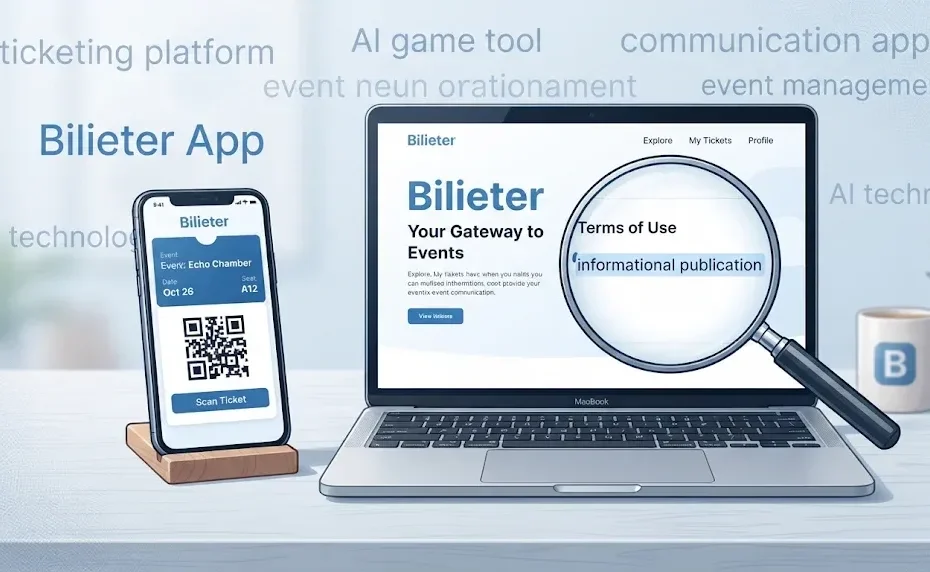
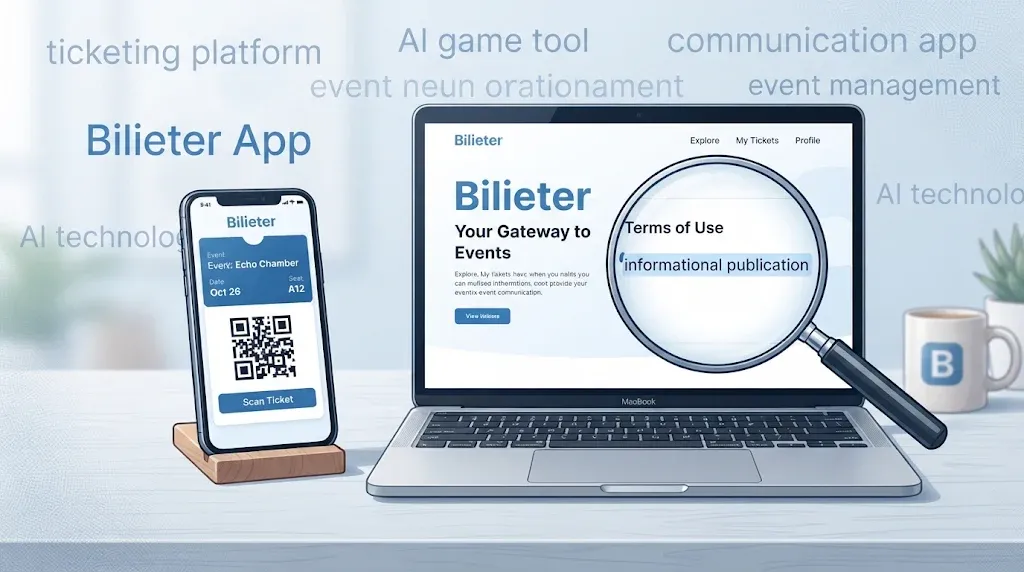
If you searched for Bilieter expecting a ticketing platform, you’re not alone. Search results are a mess. One page calls it an AI-powered ticketing system. Another says it’s a tool for building heavy bikes in video games. A third describes it as a “smart communication” platform. A fourth says it’s just a Polish word for “usher.”
The newest information available in late 2026 makes the picture clearer than ever. Bilieter.com’s own terms of use explicitly state it does not sell, broker, or guarantee tickets. An independent investigation published in September 2026 describes the name as an invented buzzword built from a real Scandinavian word. And no independent company registration, named leadership, or verified user base has surfaced for any Bilieter product—ticketing, gaming, or otherwise.
Below, you’ll learn exactly what Bilieter is today, why the misinformation spreads, and how to verify any unfamiliar name before you trust it with money, data, or development time.
Quick Overview Box
Bilieter at a glance (2026 update)
- Bilieter.com describes itself as an independent digital publication covering ticketing and event planning—not a ticket merchant or box office.
- Its terms of use (updated July 2026) say the site is monetized through Google AdSense and does not sell tickets directly.
- An independent investigation published by Celebrity Press in September 2026 found the name has no established English meaning and no track record as a recognized product before a wave of near-identical explainer articles appeared across unrelated domains.
- The name closely echoes billetter (Norwegian/Danish for “tickets”) and bileter (Polish for “ticket collector”), which explains why it sounds plausible in multiple contexts.
- The global smart ticketing market grew from $19.17 billion in 2025 to $22.03 billion in 2026, at a compound annual growth rate of 14.9%, according to Research and Markets.
- Conflicting claims about Bilieter—ticketing platform, AI game tool, communication app—are a feature of the pattern, not evidence of a real product.
1. What Is Bilieter in 2026? The Newest Answer, Straight From the Source
The most reliable information about Bilieter in 2026 comes from Bilieter.com itself. In July 2026, the site published an Editorial Policy & Event Standards page that defines its purpose in plain language.
“Bilieter is an independent digital ticketing and event planning publication dedicated to helping event organizers, venue managers, school administrators, and festival producers execute seamless live events”.
That same page includes a disclaimer that removes any ambiguity: “Bilieter operates independently and is not a direct ticket merchant or primary box office”.
The Terms of Use & Event Disclaimer, also updated in July 2026, reinforces the point. It states that Bilieter “is an informational publication and does not issue, sell, broker, or guarantee tickets for third-party events, concerts, or venues”. It also discloses that the site is “monetized primarily through Google AdSense display advertising” and that “we do not sell event tickets directly”.
So when someone asks “What is Bilieter?”, the newest and most authoritative answer is this: it is a publication about ticketing, not a ticketing platform. Any page that describes it as a product—whether a ticketing system, a game-development tool, or a communication app—is either outdated, repeating marketing language, or part of the broader pattern explained below.
2. Why the Confusion Exists: A Content-Marketing Pattern, Not a Product
If Bilieter.com says it’s a publication, why do so many pages call it something else? The answer lies in how the name spread.
An investigation published by Celebrity Press in September 2026 found that “Bilieter” has no established meaning in English and no track record as a recognized ticketing product before a wave of near-identical explainer articles began describing it as a “digital ticketing” concept. Those articles appeared across roughly nine unrelated domains—including UK magazine sites, a tech-wealth blog, and even a domain whose name suggests restaurant-menu content—none of which had an independent editorial reason to cover a single ticketing term.
The pattern is consistent with coordinated content marketing: create enough search presence around a plausible-sounding word, and readers begin to assume the word refers to something real. The name itself likely borrows from billetter, the Norwegian and Danish word for “tickets,” making it sound authentic to English speakers without being a recognizable existing brand.
A separate analysis published by Tech Trendery USA in October 2026 adds another layer. It notes that an older article on Bilieter.com described “Bilieter” as an AI-powered digital ticketing system with features such as fraud detection, dynamic pricing, and QR ticketing—but that “current public evidence does not clearly establish that product identity”.
The conflicting claims don’t stop at ticketing. The name has also been attached to a purported AI tool for generating heavy bikes in video games (via a site called Serlig) and to a “smart communication” platform (via The Perfect D). These claims are mutually incompatible. A single, real product cannot simultaneously be a ticketing SaaS platform, a game-asset generator, and a messaging app. The inconsistency itself is the tell.
3. Bilieter.com in 2026: What the Site Actually Publishes
To understand what Bilieter is today, it helps to look at what it actually publishes. As of late 2026, the site’s editorial policy describes its output as “platform reviews, ticketing guides, and security protocols” for event professionals. The site covers topics such as:
- Reducing no-show rates at events
- Badge printing and check-in workflows
- Box-office management software comparisons
- Charity gala planning
- Festival ticket pricing strategies
- Free event-ticketing systems
- Venue security and access control
These are practical, operational topics for event organizers. They are research material, not product pages. There is no pricing page, no signup flow, no app listing, and no customer account system on Bilieter.com. The site’s own editorial policy says it “leverages modern editorial technology to assist with research and layout formatting,” but that “100% of our published guides, security plans, and vendor comparisons are outlined, fact-checked, reviewed, and finalized by experienced event professionals before publication”.
This distinction matters for anyone evaluating the name. A publication can discuss QR codes, fraud detection, and payment processing without operating those systems. Discussing a technology is not the same as providing it.
4. How to Verify Any Ticketing Tool Before You Trust It
Whether you’re evaluating Bilieter or any other unfamiliar name, the verification process is the same. And it’s worth doing carefully: ticket fraud is a persistent problem, and the Federal Trade Commission has repeatedly warned that scammers exploit high-demand events with fake ticket offers. The FTC’s consumer guidance on ticket scams explains how these schemes operate and what red flags to watch for, and it’s a free resource worth bookmarking before any major purchase: FTC consumer advice on ticket scams.
Here’s a practical framework you can run in minutes:
- Look for a named company and a registration record. A legitimate ticketing provider should have identifiable leadership, a business address, and a registration you can search in a public registry.
- Check independent review platforms. Established software comparison sites and trade press coverage are stronger signals than generic explainer articles.
- Confirm that real transactions have been processed for identifiable events. A working product leaves a footprint: event listings, organizer testimonials, and support documentation.
- Read the site’s own terms. If the site says it does not sell tickets, believe it—even if other pages use product-style language.
- Test support before you pay. Send a pre-sales question. A real vendor answers; a content site may not.
For a side-by-side comparison, here’s how the Bilieter pattern stacks up against an established ticketing platform:
| Factor | Established ticketing platform (e.g., Billetto, Eventbrite) | Bilieter pattern (as observed in 2026) |
|---|---|---|
| Independent press coverage | Extensive, from tech and event-industry press | None found beyond similarly worded explainer articles |
| Verifiable company details | Named leadership, headquarters, funding history | None found |
| User reviews on independent platforms | Present on software review sites | Not found |
| Domain history | Long-established, single primary domain | Recently created cluster of domains and explainer content |
| Product documentation | Pricing pages, API docs, app listings | None found; site publishes guides only |
| Self-description | Consistent across all pages | Conflicting: “publication,” “platform,” “AI tool” |
The table is not a verdict on any individual behind the name. It is a snapshot of what independent verification currently shows—and that snapshot is thin.
5. The Real Digital Ticketing Boom—and Where Bilieter Fits
Digital ticketing is a genuine and growing industry. According to Research and Markets’ Smart Ticketing Market Report 2026, the global smart ticketing market grew from $19.17 billion in 2025 to $22.03 billion in 2026, at a compound annual growth rate of 14.9%. It is projected to reach $38 billion by 2030.
A separate report from Mordor Intelligence estimates the market at $12.5 billion in 2026**, growing to **$18.5 billion by 2031 at a CAGR of 8.16%. The figures vary because firms define “smart ticketing” differently—some include transport and tolling, others focus on events—but the direction is the same: growth.
That growth explains why a name like Bilieter attracts attention. Event organizers are actively searching for tools, and a term that sounds like ticketing can surface in those searches. But growth also raises the stakes for verification. When real money and attendee data are involved, payment security standards matter. Legitimate platforms that handle card payments typically operate within frameworks such as PCI DSS, which sets requirements for protecting payment account data. You can review the PCI Security Standards Council’s overview of PCI DSS to understand what a serious payment-handling platform should be able to explain.
A publication about ticketing does not need to meet that standard. A platform that processes payments does. Knowing which category a name falls into is the first step in evaluating it responsibly.
6. Bilieter, Bileter, Billetter: A Quick Language Breakdown
One reason the name spreads so easily is that it sounds like real words in several languages. Here’s how the spellings differ:
The phonetic overlap explains why the term feels familiar in multiple contexts. But sounding familiar is not the same as being verified. A word can resemble a real term in one language and still be an invented brand name in another.
Key Takeaways Box
- Bilieter.com describes itself as an informational publication, not a ticket-selling platform, and its terms explicitly deny selling or brokering tickets.
- An independent investigation published in September 2026 found the name has no established English meaning and no verifiable product history.
- Conflicting claims—ticketing platform, AI game tool, communication app—are a feature of the content-marketing pattern, not evidence of a real product.
- The name echoes real words in Norwegian, Danish, and Polish, which helps explain its plausible sound.
- Verify any unfamiliar ticketing tool through company records, independent reviews, and payment-security standards before sharing money or attendee data.
FAQ
Is Bilieter a real ticketing platform?
No. Bilieter.com’s own terms state it is an informational publication and does not sell, broker, or guarantee tickets. No independent evidence of a functioning ticketing product, company registration, or user base has been found.
Can I buy tickets through Bilieter?
According to the site’s own disclaimer, no. Bilieter is not a direct ticket merchant. For actual ticket purchases, use the venue, the official promoter, or a verified ticketing provider.
Why does Bilieter show up in so many different contexts?
The name appears in a cluster of explainer articles that use product-style language across unrelated domains. An investigation found roughly nine domains publishing near-identical content, a pattern consistent with coordinated content marketing.
Is Bilieter a scam?
There is no definitive proof of fraud, and the site says it is an informational resource. What can be said is that independent verification of a functioning product is currently absent, so caution is warranted.
What is the Norwegian or Polish connection to Bilieter?
Billetter is the Norwegian and Danish plural word for “tickets.” Bileter is the Polish word for a ticket collector or usher. The spelling “Bilieter” closely echoes both, which likely explains why the term sounds plausible to English speakers.
How do I check if a ticketing tool is legitimate?
Look for a named company, a registration record, independent reviews, evidence of real transactions, and clear payment-security information. If those are missing, treat the tool as unverified.
Conclusion
Bilieter is not a hidden gem or an under-the-radar platform. It is a name that borrowed the sound of real words in three languages and the language of a real industry, without ever producing the verifiable substance of a real product.
That doesn’t mean the guides on Bilieter.com are worthless. They can be useful research material. But research material is not a checkout page, and a publication is not a platform. If you’re planning an event, ask the boring questions. Check the company. Read the terms. Verify the payment flow. The right partner will welcome those questions—and the wrong one will hope you skip them.