Zecway AI: The 2026 Guide to Workplace Search, Citations, and Permission-Aware Retrieval

Introduction
Your company already knows the answer. The problem is that the answer lives in a pricing deck from six months ago, a Slack thread nobody bookmarked, and a Notion page three people have edited since. Finding it feels like detective work, and most workplace search tools only search one silo at a time.
Zecway AI is a 2026-founded, Bengaluru-based platform trying to change that. It promises a single search bar for company knowledge, answers tied to original sources, and permissions that mirror what employees can already see. But here is what most articles will not tell you: the public evidence for Zecway AI is still thin. This guide separates verified facts from vendor claims, shows you what to test, and explains where the product fits in a market already dominated by Glean and Microsoft.
Quick Overview: Zecway AI at a Glance (November 2026)
- What it is: An AI-powered workplace search platform for teams whose information is scattered across documents, messages, and business apps.
- Founded: 2026, according to its LinkedIn profile; base: Bengaluru.
- Core promise: One search interface across Google Drive, Slack, Notion, and email, with citations back to the source.
- Key architectural claim: Permissions are applied before information reaches the AI model.
- Public pricing: Not listed. Early access is request-only; no credit card required, but admission is not guaranteed.
- What is still unverified: Independent accuracy rates, security audits, connector completeness, and live customer case studies.
What Is Zecway AI and Who Is It Actually For?
Definition: Zecway AI is an early-stage workplace search platform that uses AI to connect information scattered across business tools and return answers supported by the original source material.
Zecway targets companies where knowledge is fragmented across applications. Its public positioning explicitly references Google Drive, Slack, Notion, and email, but individual connector availability still needs confirmation.
The company describes a three-layer roadmap: search first, then an assistant that helps prepare work, then agents intended to handle recurring tasks. As of November 2026, the search layer is the most concrete. The assistant and agent layers are described as ambitions, not fully released products.
Who it is for: Teams large enough to have fragmented information but not large enough to build internal search engineering. Think 30 to 500 people with real retrieval friction.
Who should wait: Organizations with broken underlying knowledge management. If policies are missing or permissions are already too broad, an AI interface will expose those problems, not fix them.
The Real Problem Zecway Tries to Solve and Why It Matters in 2026
Most companies do not have a knowledge shortage. They have a knowledge retrieval problem. A pricing decision lives in a sales presentation; the explanation survives only in a messaging conversation. Conventional search operates inside individual apps, so the context connecting results sits elsewhere.
This pain is measurable. According to the UK government’s 2026 AI adoption survey, 32% of UK businesses were using at least one AI technology in 2026, up from 16% in 2025. As more work moves into AI-assisted workflows, the cost of scattered institutional knowledge compounds, and the demand for traceable, permission-aware retrieval grows with it.
Zecway’s proposition is simple: make scattered material discoverable through one interface, and show the evidence behind every answer so employees can judge whether the source is current and approved.
How Zecway AI Works: Search, Citations, and Permissions
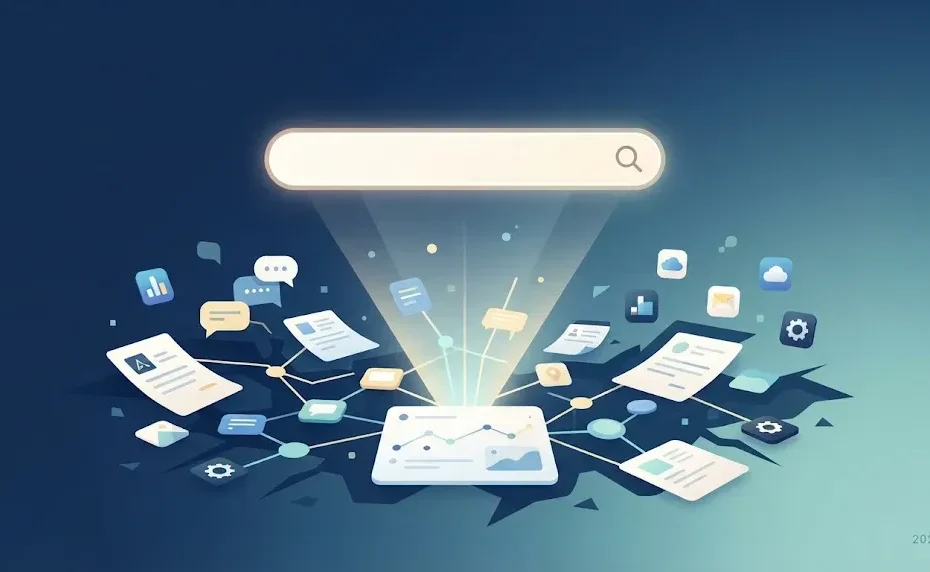
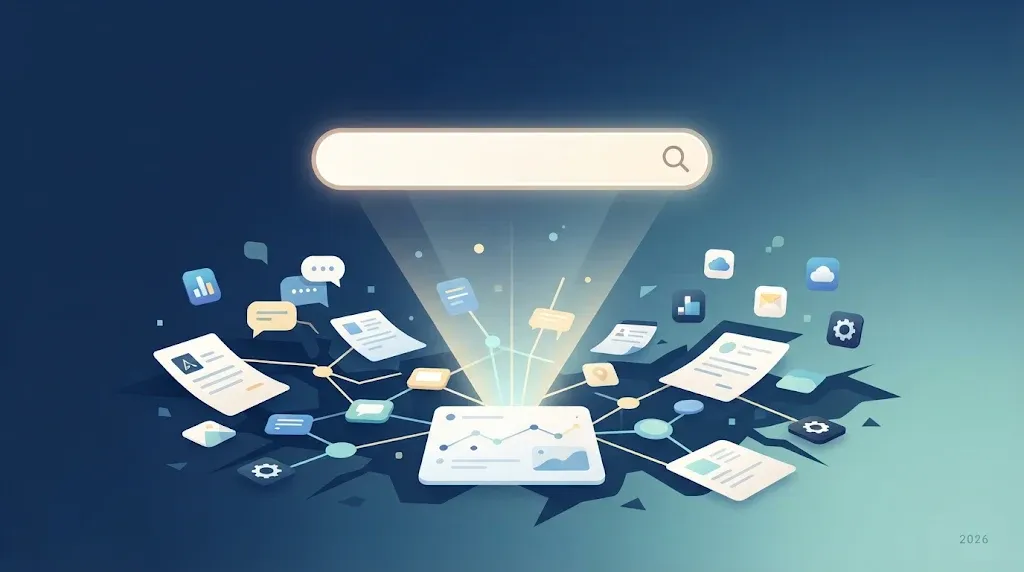
The Search Bar That Carries Context
Zecway’s public demo shows a question about the “latest pricing deck.” The result returns a document and a related Slack discussion, joining files with the conversations that explain them. This is a demonstration, not independent testing.
The Three-Layer Answer
- Connectors pull from Google Drive, Slack, Notion, and email. Availability per connector is unconfirmed.
- A knowledge graph seeks connections between records rather than isolated files.
- Grounding attaches citations to every answer, so users can inspect the underlying source.
The 0.4-Second Claim and What It Actually Means
Zecway’s marketing presents an answer time of approximately 0.4 seconds. That is a vendor claim, not a guaranteed response time. Actual speed depends on source systems, indexing, and query complexity.
The Permission-Aware Architecture
Zecway says its system applies permissions before information reaches the AI model, so different employees receive results appropriate to their existing access. That is the right architecture for enterprise trust. But it is a stated design feature, not independent certification, a distinction that matters when you are connecting HR files or confidential commercial discussions.
Why a Traceable Answer Matters More Than a Confident One
Zecway emphasizes citations attached to answers. Instead of an unsupported paragraph, the system identifies the underlying material so users can inspect the reasoning. This belongs to a wider approach called grounding: drawing on retrievable organizational information when generating responses.
Grounding improves transparency. It cannot guarantee correctness. A cited source might itself be outdated, poorly written, or inconsistent with another authorized document. The quality standard should therefore include source relevance, freshness, and ease of verification.
For businesses, this is the difference between an AI that sounds confident and an AI that helps you distinguish an approved instruction from a casual comment, and an illustrative example from a contractual commitment.
Privacy, Permissions, and the Trust Gap: What Buyers Must Test
Permission-aware retrieval is not the same as a complete security assessment. Customers still need to establish how connections are authorized, where data is processed and stored, how retention works, and how access changes are synchronized.
If your organization processes personal data in the UK, UK GDPR and ICO guidance on AI and data protection apply. Depending on the nature and risk of processing, a data protection impact assessment may be required. The ICO’s guidance on AI and data protection sets out expectations for fairness, transparency, and accountability.
A controlled trial should deliberately test restricted HR files, confidential commercial discussions, and revoked permissions. The question is not just “Can Zecway find the answer?” It is “Does it consistently refuse to disclose information to someone who should no longer see it?” Marketing materials cannot settle that. Only your own security scenarios can.
Zecway AI vs. Glean vs. Microsoft: The November 2026 Comparison
Zecway enters a field where established providers already offer cross-application discovery and AI assistance. Glean promotes permissions-aware enterprise search with source-backed answers and more than 100 connectors across Google Drive, Confluence, Slack, and Salesforce. Microsoft provides retrieval built around organizational information and access controls.
The combination of search, citations, and permissions is not unique by itself. A smaller entrant needs to demonstrate why its experience is easier to deploy, more useful for its target market, or better suited to specific workflows.
Comparison Snapshot
- Public pricing: Zecway does not list pricing; Glean uses custom enterprise pricing. Request written terms from both.
- Connector count: Zecway names four sources; Glean documents 100+ connectors. Confirm live versus planned connectors.
- Permission architecture: Zecway says permissions are applied before the AI model; Glean uses a permissions-aware knowledge graph. Revoke access mid-test and check result freshness.
- Independent accuracy data: Zecway has none publicly available; Glean publishes vendor comparative evaluations. Run your own 20-question benchmark.
- Citation mechanism: Both claim source-backed answers. Check whether the newest approved version surfaces.
- Market maturity: Zecway is 2026-founded and early access; Glean is established. Ask for customer references in your size band.
Publicly available Zecway information does not support a defensible ranking against Glean or Microsoft as of November 2026. That is an early-stage reality, not a criticism. Compare tools using your queries and your security scenarios, not vendor demos.
Availability, Pricing, and What You Can Actually Try Today (Updated November 2026)
As of November 2026, Zecway’s public website invites visitors to request limited early access with a work email. No credit card is required for that request, but registration does not promise admission or free service.
There is no conventional subscription price list on the main landing page. The absence of a payment requirement for early access does not establish that future production use will be free. Before budgeting, request written pricing, usage limits, and commercial terms directly.
A sensible pilot would begin with a limited, authorized document collection and a set of realistic questions. Measure how often staff find the correct source, how often they need to challenge an answer, and whether permissions survive changes to user access. For any automation feature, require a clear audit trail and human approval for consequential actions.
Entity verification note: The Zecway name appears in older Indian business records for a marketing and creative firm called Zecway Studio LLP, incorporated in 2024. The current AI-focused LinkedIn profile describes a privately held software business founded in 2026. The relationship between the two has not been clearly established in accessible primary materials. Before contracting, verify the exact legal entity, ownership information, and data processor. This is standard supplier due diligence, not an allegation of wrongdoing.
Who Should Consider Zecway AI and Who Should Wait?
Consider it if:
- You run a 30 to 500-person team with reasonably reliable records but chronic retrieval friction.
- Your sales team loses time hunting for approved pricing language.
- You want citations and permission-aware search without building an internal search function.
Wait if:
- Your underlying knowledge management is broken.
- Policies are missing, permissions are excessively broad, or documents contradict each other.
- You need published pricing, independent security audits, and live customer references before committing.
Better discovery reveals the quality of existing knowledge management. It does not replace it.
Key Takeaways
- Zecway AI is an early-stage (2026) workplace search platform, not a general-purpose chatbot. Its core job is connecting scattered company knowledge and citing the source.
- Permission-aware retrieval is the trust feature to test hardest. Marketing claims are not security certifications.
- Early access is not public availability. Confirm which connectors, assistant features, and agent workflows are live before committing.
- Pricing is not published as of November 2026. Get written terms, usage limits, and data-processing details before budgeting.
- The market is crowded. Glean and Microsoft already offer cross-app search with permissions. Compare retrieval quality and permission fidelity using your own queries.
FAQ
What is Zecway AI used for?
Zecway AI is used to search across business tools like Google Drive, Slack, Notion, and email, returning answers with citations to the original source. It is designed for teams that need to find approved documents, trace decisions, and reduce time spent hunting for information across disconnected apps.
Is Zecway AI free?
No public subscription price is displayed as of November 2026. The website offers a limited early-access request with no credit card required, but that does not guarantee free production use. Request written pricing and commercial terms directly before making a budget decision.
Does Zecway AI respect existing file permissions?
Zecway says its system applies permissions before information reaches the AI model, so employees only see results they already have access to. This is a stated design feature, not independent certification. Test revoked access, confidential files, and permission changes during a pilot.
How is Zecway AI different from Glean?
Both emphasize permissions-aware search and source-backed answers. Glean has a longer public track record and 100+ documented connectors. Zecway is earlier-stage and positions itself for smaller teams. The meaningful difference comes down to retrieval quality and admin overhead in your own environment.
Is Zecway AI available to everyone?
No. As of November 2026, the main website offers a limited early-access registration process. Submitting a work email does not guarantee admission, and no public release date has been announced for all planned capabilities.
Can Zecway AI draft documents or automate tasks?
The company describes an assistant that can draft replies and summaries using company records, plus agents for recurring tasks with human approval steps. These features are part of the roadmap, and availability should be confirmed directly rather than assumed from marketing examples.
Conclusion
Zecway AI is worth watching because it targets a problem every growing team recognizes: the answer exists, but finding it costs too much time. Its emphasis on citations and permission-aware retrieval addresses the two concerns that actually block workplace AI adoption, trust and access control.
But the deciding factor should not be a polished demo or a 0.4-second speed claim. It should be demonstrated reliability with your information, your permissions, and your real questions. Ask for a pilot. Test the edge cases. Verify the legal entity. If the platform performs under those conditions, it earns a place in your stack. If it does not, you have learned something valuable before connecting your most sensitive files.