Math Playzone: What Every Parent and Teacher Needs to Know Before Hitting “Play”

Introduction
Math practice often feels like a chore, for the child and the adult. Math Playzone enters that space with a simple promise: make numbers feel like play. The platform offers browser games and a companion app that blend arithmetic drills with arcade-style challenges. This guide examines what Math Playzone actually delivers, separates the learning from the entertainment, and shows you how to use it without letting the “fun” side erase the “math” side. Expect clear breakdowns, research context, and practical guardrails.
What Is Math Playzone, Exactly?
Math Playzone is not one product with one identity. The name refers to two related but distinct experiences that parents and teachers encounter.
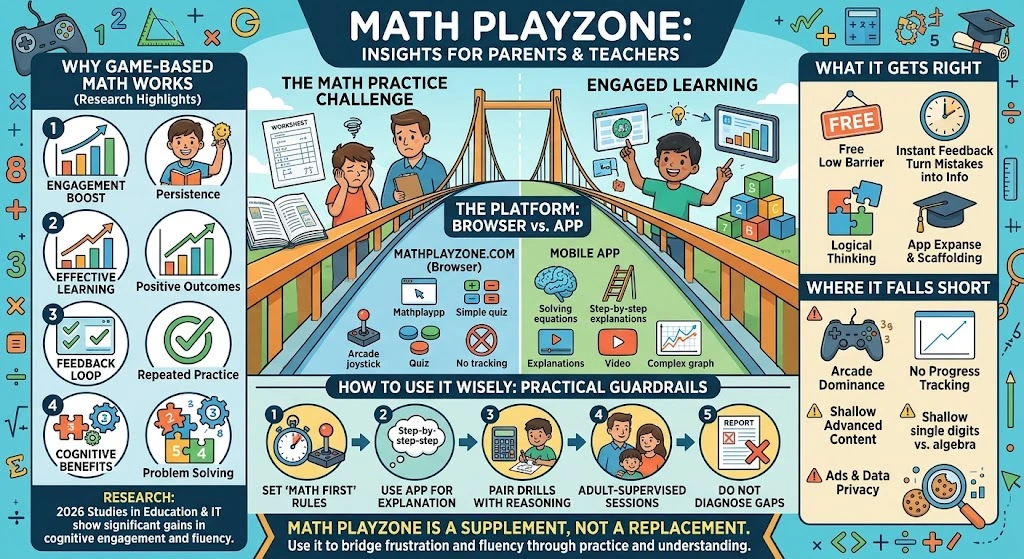
The browser site (mathplayzone.com) presents itself as “Games for Learning and Fun.” Its learning tabs, Math, Science, History, and Geography, hold roughly sixteen quiz-style titles covering single operations and basic facts. The Arcade tab, by contrast, lists more than 120 games, most labeled “unblocked” and many unrelated to mathematics at all.
The mobile app takes a different shape. The App Store listing describes comprehensive topic coverage including algebra, calculus, trigonometry, and probability, an AI-powered solver with step-by-step explanations, interactive quizzes, a graphing calculator, and video lessons. These are meaningfully different capabilities from the browser’s arcade-first layout.
This distinction matters. A parent searching for “math practice” on a school-night browser may land on a page that is, by volume, an entertainment portal. A teacher recommending an app may be directing students to a tool with more structured academic intent. Knowing which version you are using prevents a common disappointment: expecting a curriculum and receiving a quick drill.
Why Game-Based Math Practice Draws So Much Attention
The appeal of platforms like Math Playzone is not accidental. A substantial body of peer-reviewed research shows that gamified mathematics tasks can shift how students engage with the subject.
A 2026 mixed-methods study published in Education and Information Technologies tracked fifth-grade students using a digital gamified platform. The researchers found significant increases in overall engagement, particularly in behavioral and cognitive domains. Rewards, adaptive challenges, and time-based tasks were linked to greater participation, persistence, and strategic thinking. Students described enjoyment and active participation. Teachers observed peer interaction and persistence.
Larger syntheses point in a similar direction. A second-order meta-analysis reported an overall mean effect size of 0.45 for game-based learning on mathematics outcomes. Another meta-analysis calculated a Hedges’s *g* of 0.651 when game-based learning was compared with traditional teaching methods. A separate synthesis found a moderate-to-large effect of gamification on math learning, with a mean effect of 0.444, and consistent positive outcomes across educational levels.
These numbers do not mean any game labeled “math” will raise a score. They mean the structure of well-designed games, immediate feedback, escalating challenge, and visible progress, aligns with how many learners build fluency. The question for Math Playzone is whether its design captures that structure or merely borrows the label.
What Math Playzone Gets Right
Free access lowers the barrier to practice
The browser platform and many of its games are free to access. For a family that wants to add low-pressure arithmetic practice without a subscription, that accessibility has real value. The app offers a free tier with optional in-app purchases for premium features, with annual pricing below what many tutoring sessions cost.
Immediate feedback turns mistakes into information
Game-based drills provide instant correction. A wrong answer is not returned a week later on a graded worksheet. It is flagged in the moment, giving the learner a chance to adjust. Research on gamified retrieval practice consistently links this kind of immediate, repeated feedback to fact fluency. Math Playzone’s quiz-style games follow this model, even when the surrounding design is simple.
Puzzle and logic games train more than arithmetic
The platform includes puzzle-style challenges that exercise deductive reasoning, pattern recognition, and working memory, skills that sit underneath mathematics without always appearing on a worksheet. Sudoku-like grids, number-sequence challenges, and timed calculation sprints ask the brain to hold information, apply rules, and adjust under mild pressure. These are legitimate cognitive workouts, especially for older elementary and middle-school students who have mastered basic operations and need fluency under time constraints.
The app adds explanatory scaffolding
The AI-powered solver and step-by-step explanations in the mobile app address a gap that many free drill sites leave open. A student who gets a problem wrong can see why, not just that they were wrong. Video lessons and a graphing calculator extend the app beyond arithmetic into algebra and pre-calculus territory. For a motivated learner, these features create a bridge between practice and conceptual understanding.
Where Math Playzone Falls Short
The browser experience is arcade-heavy
An honest look at mathplayzone.com reveals a structural imbalance. The learning sections contain roughly sixteen titles. The arcade contains about 120, and many arcade games have no mathematical content whatsoever. The site does not name an owner, team, or editorial reviewer on its public pages, and its privacy policy allows advertising networks to use tracking technologies. Trust-score analyses describe the site as legitimate and not a scam, but also note that the operator’s identity is hidden behind WHOIS privacy and that the domain has a relatively young history.
What this means practically: the browser site is not a curriculum. It is a collection of quick drills wrapped in an arcade. A child left alone with it will likely spend most of their time on non-math games.
Progress tracking and adaptivity are limited on the web version
A critical review of the browser site notes that the learning games offer “no levels, tracking, or teacher tools.” The platform does not adapt difficulty based on performance, nor does it produce a record a teacher can review. For a parent trying to gauge whether practice is working, that absence is significant. Games that feel productive can still produce no measurable learning signal.
The learning curve is shallow for advanced students
The browser’s math titles center on basic operations and simple quizzes. Students working above grade level, or preparing for algebra, geometry, or standardized exams with multi-step reasoning, will exhaust the academic content quickly. The app’s broader topic coverage addresses this gap, but the free browser experience does not.
Ads and tracking require adult awareness
The site uses Google Analytics and works with an advertising company. Ad networks may collect IP address, device details, location, and browsing information. For a classroom or a young child’s device, those data practices deserve a conversation before the first click. The app’s privacy disclosures also indicate diagnostic data collection and the presence of advertising in the free tier.
How Math Playzone Compares to the Research Ideal
Research on effective game-based math learning identifies several design features that separate productive games from empty entertainment: adaptive challenge, clear learning goals, progress visibility, and explanations that connect procedure to concept.
Adaptive difficulty: Research shows that adjusting to learner performance sustains engagement without frustration. The Math Playzone browser does not present this on its web learning games. The app does not explicitly describe it in the public listing.
Progress tracking: Research shows that making growth visible supports persistence. The browser site does not offer it. The app does not describe it in the App Store listing.
Concept explanations: Research shows that connecting correct answers to underlying ideas matters. The browser offers minimal quiz-style feedback. The app includes an AI solver and step-by-step explanations.
Curriculum alignment: Research shows that tying practice to grade-level standards helps. The browser does not indicate alignment. The app lists topic coverage, but alignment is not specified.
Entertainment balance: Research shows that games should serve learning goals, not replace them. The browser is dominated by the arcade by volume. The app places quizzes and lessons closer to the center.
The pattern is clear. The app moves closer to the research ideal than the browser site. The browser experience prioritizes access and volume. The app adds explanatory depth. Neither is a full substitute for structured instruction, but the app’s design choices suggest a more deliberate learning intent.
How to Use Math Playzone Without Wasting Time
Set a “math first” rule for the browser. Ask your child to complete one or two learning-tab games before the arcade unlocks. The site does not enforce this boundary. You must. Without it, the arcade’s volume will absorb the session.
Use the app for explanation, not just repetition. When a problem goes wrong, the step-by-step solver is the feature worth paying attention to. Ask your child to explain the step back to you. That retrieval, putting the reasoning into their own words, is where the app’s value compounds.
Pair timed drills with untimed reasoning. The platform’s timed challenges build speed, but speed without understanding plateaus. Balance quick arithmetic sprints with a separate, low-pressure problem that requires drawing, modeling, or talking through a strategy. Research on gamified learning consistently shows that engagement gains are strongest when games support, rather than replace, conceptual work.
Check the device and the data settings. Use the browser site on a shared or supervised device. Review the privacy settings, and treat the advertising disclosures as a reason to keep the session adult-adjacent for younger children. The site is rated for broad audiences, but the data practices are not child-specific.
Do not expect the browser to diagnose gaps. If you need to know what your child is missing, not just whether they can tap the right answer, the browser site will not tell you. A teacher’s observation or a diagnostic tool will. Use Math Playzone as a practice supplement, not an assessment.
A Realistic Verdict
Math Playzone is neither a hidden gem nor a villain. It is a free practice tool with a split personality. The browser side delivers quick, low-stakes arithmetic exposure wrapped in an arcade that will dominate a child’s attention if left unmanaged. The app side adds explanatory features, including AI solving, step-by-step reasoning, and video lessons, that give it more academic substance, though the free tier comes with ads and the premium tiers require payment.
The research on gamified math learning is encouraging, but it describes design principles, not brand names. A platform earns the research-backed benefits when it adapts to the learner, makes progress visible, and connects answers to ideas. Math Playzone’s app moves in that direction. The browser site mostly does not.
Use it with intention. Put the learning tab first, keep the arcade on a leash, and treat the app’s explanations as the feature worth your attention. Under those conditions, Math Playzone can serve as a useful bridge between “I don’t want to practice” and “I just solved it.”
Your next step: open the platform with your child or student, complete one learning game together, and ask a single question afterward: “What did that game make your brain do?” The answer will tell you more about the session’s value than any score on the screen.