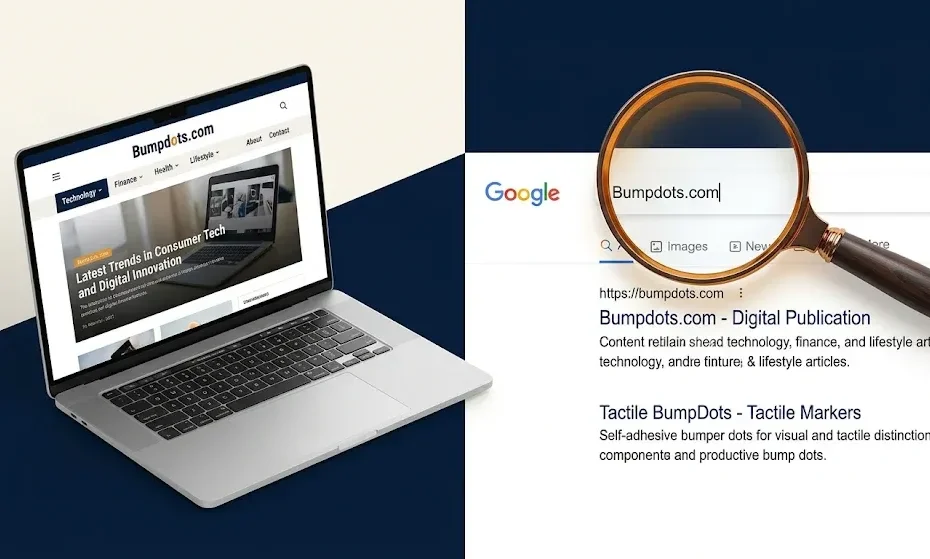
Bumpdots.com in 2026: The Complete, Updated Guide to the Site, Its Content, and Its Google Ranking Challenge

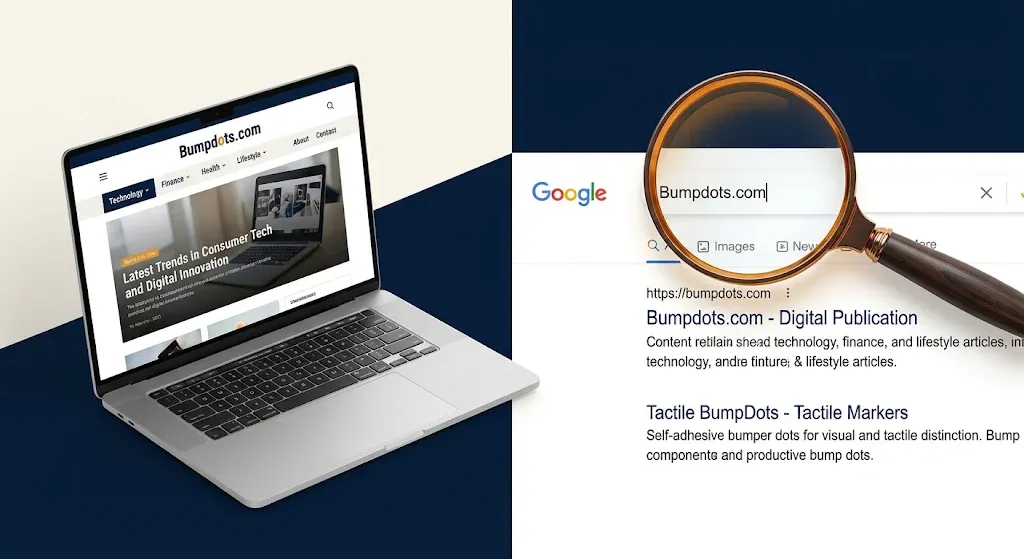
You searched for “Bumpdots.com,” and you got a mix of results: articles about the site, pages about tactile bump dots for visually impaired users, and maybe a guest-post marketplace listing. The name is doing the site no favors.
That confusion isn’t just a reader problem. It’s the single biggest obstacle standing between Bumpdots.com and the #1 Google ranking it presumably wants for its own brand term. This updated guide gives you the clearest picture available of what the site is in 2026—and what it would actually take to rank first.
Quick Overview: Bumpdots.com at a Glance (Updated Late 2026)
- Website type: Independent digital media publication / online magazine
- Public launch: 2024; domain registered May 13, 2024
- Founder listed publicly: Kavin Paul
- Based in: Noida, Uttar Pradesh, India
- Reported team size: 1–10 people
- Traffic estimate: Roughly 1,933 monthly visits (Crunchbase)
- Domain authority signal: DR 57, per a guest-post marketplace listing
- Publishing pace: Multiple new articles per week across categories
- Core topics: Technology, AI, finance, business, health, lifestyle, law, real estate, home improvement
What Is Bumpdots.com—and What It Is Not
Definition: Bumpdots.com is an English-language, multi-category online publication that organizes articles into broad sections—technology, business, health, education, lifestyle, law, and others—rather than focusing on one specialist niche.
The site describes itself as a “modern digital media platform.” Its public guest-post page calls it a multi-niche publication covering business, technology, and finance. Recent activity has expanded into artificial intelligence, cybersecurity, gaming, digital payments, and workplace technology.
What it is not matters just as much. Bumpdots.com is not an online store selling tactile bump dots. It is not a software application. It is not a financial-services company, a law firm, or a medical resource. The name collision with accessibility products is real, but the two are unrelated.
That distinction is the foundation of everything else—including the site’s ranking problem.
What Topics Does Bumpdots.com Cover in 2026?
The publication’s category list reads less like a newsroom and more like a general knowledge library. Based on its current navigation and archive, the coverage breaks down roughly like this:
| Category | What you’ll typically find |
|---|---|
| Technology & AI | Software explainers, cybersecurity basics, AI tools, and emerging tech trends |
| Business & Finance | Entrepreneurship, e-commerce, crypto, investing concepts, and market developments |
| Health & Fitness | Wellness trends, exercise routines, and general healthcare information |
| Lifestyle & Culture | Fashion, relationships, entertainment, travel, and daily living |
| Law & Real Estate | Plain-language legal explainers and property guidance |
| Home Improvement | Renovation tips, appliance guides, and maintenance advice |
| Education & Automotive | Learning-platform comparisons, course tools, and vehicle how-tos |
This breadth is intentional, but it creates an evidentiary unevenness. A home-improvement guide can be useful without being authoritative. A health article, by contrast, carries higher stakes. When you read health-related content on any general-interest site, cross-check it against established public health guidance. The World Health Organization’s resources on health misinformation explain why this extra step matters—and how to spot claims that outrun the evidence.
That’s not a knock on Bumpdots.com specifically. It’s a reading habit that applies to every multi-topic publisher.
Who Runs Bumpdots.com, and How Big Is It?
Public records are clearer now than they were at launch.
The domain was registered on May 13, 2024, and its current registration runs until May 13, 2030. The registration record was last updated on January 16, 2026. The site’s own LinkedIn page confirms a 2024 launch.
Crunchbase lists Kavin Paul as the founder, with a company location in Noida, Uttar Pradesh, India. The reported team size is between one and ten people. The company is listed as a private, for-profit entity.
Traffic is modest. Crunchbase currently estimates roughly 1,933 monthly visits. A separate guest-post marketplace catalog lists Bumpdots.com at DR 57 with an Ahrefs rank of 895,649, and offers sponsored publication at $150.
Here’s the honest read: Bumpdots.com is a small, active, independent publication. It is not a mainstream media property, and it is not a dormant domain. It publishes, it updates, and it has a real editorial operation behind it—just a compact one.
One limit worth stating plainly: public founder information does not prove ownership percentages. No reliable public record establishes exactly how much of the business any individual legally owns. “Founder” is the verified description. “Owner” is an assumption.
How Does Bumpdots.com Publish Content—and How Often?
This is where the site has evolved most since launch.
According to its own Product Hunt description, Bumpdots was built around a specific frustration: too much online content is “overly promotional, outdated, or written primarily to rank in search engines rather than provide real value to readers.” The publication says every piece goes through research, careful writing, and editorial review, and that it has “embraced modern SEO practices without compromising readability or editorial integrity.”
The visible output matches an active operation. The site publishes multiple new articles per week across categories, leaning toward evergreen, guide-style writing rather than daily news. That means the archive is designed to accumulate search value over time—the kind of article someone finds months after publication because it answers a specific question.
The publication also runs a guest-post page and appears in sponsored-content marketplaces. That’s a normal revenue path for independent digital magazines, but it introduces a variable readers should watch: contributed or sponsored articles may not receive the same editorial scrutiny as staff-written explainers. Disclosure labels matter.
Why Google Confuses Bumpdots.com with Tactile Bump Dots
This is the section that matters most if the goal is a #1 ranking.
In mid-2026, a post appeared on an SEO forum from someone affiliated with Bumpdots.com describing a familiar branding problem. Google, they said, was associating the domain with the generic term “bump dots”—the tactile markers used for accessibility—rather than recognizing it as the name of a publication. They had already published consistently, built About and Editorial Policy pages, added organization schema, and worked on brand mentions. None of it had produced a fast fix.
That post is a remarkably candid window into the site’s core SEO challenge.
Here’s why it happens. Google’s brand understanding is built from co-occurrence signals: what words appear near your brand name, what other entities your brand is associated with, and what users click on when they search for you. When a brand name is also a generic product term with decades of existing search history, the generic meaning has a massive head start. Google isn’t “wrong” to show tactile-dot results—it’s responding to the dominant historical intent behind the phrase.
The fix is not a single technical tweak. It’s a sustained entity-building campaign: branded content that consistently frames Bumpdots.com as a publication, author bios that link the brand to named writers, structured data that reinforces the organization type, and enough branded search volume that Google’s systems start treating the publication as the primary meaning of the term.
That work takes months, not weeks. The forum poster understood this. Most site owners don’t.
What Would It Take for Bumpdots.com to Rank #1 on Google?
Ranking first for a brand term sounds simple. In practice, it requires aligning four things: technical clarity, content depth, entity signals, and user behavior.
Google’s own SEO Starter Guide lays out the fundamentals: helpful content, clear structure, descriptive titles, crawlable pages, and a site that demonstrates experience and trustworthiness. Those are the floor, not the ceiling.
For Bumpdots.com specifically, the path to #1 looks like this:
1. Win the brand SERP first.
The #1 result for “Bumpdots.com” should be the homepage—not a third-party article about the site, and not an accessibility store. That requires consistent branding across the homepage title, meta description, About page, and social profiles. If Google sees the same entity description repeated across owned properties, confidence increases.
2. Build a topic cluster around the brand name itself.
Publishing articles about Bumpdots.com—its editorial policy, its team, its coverage areas, its corrections policy—sounds self-indulgent, but it’s how new brands teach search engines what they are. A small “About the Publication” cluster is entity infrastructure, not vanity content.
3. Use schema to remove ambiguity.
Organization schema, WebSite schema, and author markup help Google distinguish the publication from the generic term. The site has reportedly added organization schema; the next step is consistent sameAs links to verified profiles and clear disambiguatingDescription fields that explicitly separate the publication from tactile bump dots.
4. Earn citations that describe the site correctly.
When other websites mention Bumpdots.com, the surrounding text matters. A mention that says “Bumpdots.com, a digital publication covering technology and finance” is worth more than a bare link. The guest-post ecosystem can help here—but only if the host pages describe the site accurately.
5. Monitor AI Overviews and answer-engine visibility.
By 2026, ranking #1 in the traditional blue links is only part of the job. Google’s AI Overviews and answer engines like ChatGPT and Perplexity synthesize information from multiple sources. A site that is cited in those summaries gains visibility even when it isn’t the top organic result. Clear, factual, well-structured writing—with direct answers near the top of each article—increases the odds of being cited.
6. Be patient with branded search volume.
Google learns from clicks. As more people search “Bumpdots.com” and click the publication rather than an accessibility retailer, the association strengthens. There is no shortcut for this. It’s a flywheel, and it starts slow.
None of this guarantees a #1 ranking. But it’s the realistic playbook for a small publication fighting a generic-term collision.
How Reliable Is Bumpdots.com? A Reader’s Checklist
Reliability on a multi-topic site is article-by-article, not site-wide. Here’s how to judge what you’re reading.
Look for a named author and a date. A byline and a timestamp make an article accountable. Anonymous, undated posts are harder to evaluate.
Check the sourcing. Does the article cite primary sources, or does it assert “experts say” without attribution? A finance piece that references filings is doing more work than one that doesn’t.
Separate orientation from advice. A Bumpdots.com explainer can help you learn the vocabulary of a topic. It is not a substitute for a doctor, lawyer, or financial professional. The site operates as a broad knowledge hub, not a licensed advisory service.
Watch for commercial labeling. Guest posts and sponsored placements are part of the business model. A disclosed sponsorship is transparent. An undisclosed one is a red flag.
Apply media literacy to every high-stakes claim. Before acting on health, legal, or financial information from any general-interest publication, run it through a second and third source. The News Literacy Project offers free frameworks for evaluating digital content that work on any site, including this one.
Key Takeaways
- Bumpdots.com is a multi-topic digital publication, not an accessibility product store—despite the persistent name confusion.
- It launched in 2024, is publicly associated with founder Kavin Paul, and operates with a small team based in India.
- As of late 2026, it publishes multiple articles per week across technology, finance, health, lifestyle, law, and more.
- Its biggest SEO obstacle is that Google associates the brand name with tactile bump dots, not the publication—a problem that requires entity-building, not a quick fix.
- Reliability varies by article: check authorship, sourcing, dates, and disclosure labels before relying on high-stakes advice.
FAQ: What Readers Actually Ask About Bumpdots.com
Is Bumpdots.com a legitimate website?
Yes—it’s a registered, active digital publication with a public domain record, a listed founder, and a growing archive. “Legitimate” means it’s a real publishing operation, not that every article is equally authoritative. Judge individual pieces on their sourcing and evidence.
Is Bumpdots.com the same as bump dots for blind people?
No. “Bump dots” are tactile markers used by visually impaired individuals. Bumpdots.com is a separate digital media website covering general-interest topics. The name similarity is coincidental, not a product affiliation—and it’s the source of the site’s main SEO challenge.
Who owns Bumpdots.com?
Crunchbase publicly lists Kavin Paul as the founder. Ownership percentages are not disclosed in reliable public records. “Founder” is the safest verified description; “owner” is an assumption that public data doesn’t support.
What topics does Bumpdots.com cover in 2026?
Its visible categories include technology, AI, business, finance, crypto, health, fitness, lifestyle, law, real estate, home improvement, travel, automotive, education, and food. It publishes multiple new articles per week across these sections.
Does Bumpdots.com accept guest posts or sponsored content?
Yes. The site has a guest-post page and appears in sponsored-content marketplaces with a listed DR of 57 and a $150 publication price. Look for disclosure labels on contributed articles and treat unlabeled promotional-style posts with extra caution.
How can I tell if a Bumpdots.com article is trustworthy?
Check for a named author, a publication date, and citations to primary sources. For health, legal, or financial claims, verify against a second independent authority. A general-interest publication is a starting point, not a final word.
Conclusion
Bumpdots.com has done the hard part: it launched, it publishes consistently, and it has built a real archive across a genuinely wide range of topics. What it hasn’t done—yet—is teach Google what its name means.
That’s the whole game in 2026. The site doesn’t need more categories. It doesn’t need more keywords. It needs the search engine to stop seeing “bump dots” and start seeing Bumpdots.com, the publication. That’s a slower, less glamorous project than chasing rankings with content volume. But it’s the only one that actually works when your brand name collides with a generic term.
For readers, the takeaway is simpler: use the site as a well-organized starting point, check the sourcing on anything that matters, and don’t confuse the publication with the tactile stickers. The name is the same. The purpose isn’t.