Pyntekvister in 2026: The Updated Guide to Scandinavian Branch Decor That Actually Fits How We Live Now

Something shifted in 2026. The design conversation stopped treating “bringing nature in” as a nice-to-have and started treating it as a baseline expectation. Houzz searches for biophilic design jumped 112% year over year in early 2026. IKEA’s 2026 Style Guide made Lagom Living—the Swedish idea of “just the right amount”—a headline trend, built around calm, natural materials, and intentional restraint. And in that climate, pyntekvister stopped being a word you had to explain.
If you’ve seen a single sculptural branch in a tall vase and felt the room exhale, you’ve already met the idea. This updated guide covers what’s changed, what the newest data says, and how to make branch decor work in a real home—not just a mood board.
Quick Overview: What’s Different in 2026
- Biophilic demand is measurable. “Biophilic design” searches more than doubled year over year in early 2026.
- Lagom Living replaced pure minimalism. The new mood is “not too much, not too little”—warm, functional, and calm.
- Sustainability is now a purchase criterion, not a bonus. 58% of online shoppers consider sustainability when buying home goods, and 68% will pay more for it.
- Branch decor fits the moment because it’s low-cost, biodegradable, and visually aligned with the Lagom aesthetic.
- Forcing branches indoors is easier than most people think—with a few updated rules from botanical gardens.
What Does Pyntekvister Mean—and Why Is It Everywhere Now?
Definition: Pyntekvister is a Norwegian and Danish term combining pynte (“to decorate”) and kvister (“twigs” or “branches”). It describes branches chosen and arranged indoors for their line, texture, or seasonal meaning—not for flowers alone.
The word is old. The behavior is what’s new again. For decades, branch decor lived in the background of Scandinavian homes: birch stems at Easter, pussy willow in early spring, bare twigs against a pale wall in winter. In 2026, that quiet habit has become a visible design strategy because it solves three problems at once.
First, it answers the biophilic brief without the cost and care of a room full of plants. Second, it fits the Lagom Living mood—intentional, warm, restrained—better than another mass-produced accessory. Third, it’s almost impossible to make look “trendy” in the bad sense. A branch doesn’t go out of season.
Why Are Branches Suddenly Central to 2026 Interiors?
Three data points explain the shift better than any style forecast.
Biophilic design went mainstream. The global biophilic design and nature-integrated interiors market was valued at $53.3 billion in 2025 and is projected to grow at 13.5% annually through 2032. That’s not a niche aesthetic anymore. It’s an expectation.
Lagom Living reframed minimalism. IKEA’s 2026 guide explicitly moved away from cold whites and icy greys toward creamy neutrals, sandy beiges, forest greens, and natural materials like wood, stone, and rattan. A bare branch in a stoneware vase is Lagom in physical form: enough to add life, not so much that it clutters.
Consumers are voting with their wallets. PwC data shows 58% of online shoppers factor sustainability into home-goods purchases, and 68% will pay a premium for it. A branch that comes from a pruned garden or a local florist sits at the intersection of cost and conscience.
The 2026 Trend Snapshot
| Force | 2026 Signal | What It Means for Branch Decor |
|---|---|---|
| Biophilic demand | Houzz searches +112% YoY | Branches are a low-barrier entry point |
| Lagom Living | IKEA’s headline 2026 trend | Restraint and warmth beat stark minimalism |
| Sustainability | 58% of shoppers consider it | Natural, biodegradable decor gains value |
| Pinterest Predicts 2026 | “Comfort and authenticity” | Personal, imperfect, natural looks favored |
How Do You Choose Branches and a Vase That Actually Work Together?
The branch-and-vase relationship is still where most displays succeed or fail—but 2026’s looser, warmer interiors give you more room to experiment than the strict Scandi rulebook did.
Use this updated checklist:
- Start with the line, not the flower. A single curve or fork is enough. Straight birch feels architectural; twisted willow feels organic; forked branches add graphic interest.
- Match height to the room, not the vase alone. In a Lagom-style interior, the arrangement should feel intentional but not dominant. A floor vase needs branches at least 1.5 times its height; a table arrangement should sit below seated eye level.
- Choose a stable, natural-material base. Stoneware, matte ceramic, glass, or a weighted pin holder. Avoid lightweight plastic vessels with heavy branches.
- Use odd numbers. Three stems read as natural; even numbers often look arranged.
- Leave negative space. The space around the branch is part of the design. Don’t fill the vase to the brim.
A common 2026 mistake is over-styling. The whole point of this trend is that it looks like you brought something in from outside and put it down. If it looks like a florist engineered it, you’ve gone past Lagom.
Can You Still Force Branches to Bloom Indoors? Yes—Here’s the Updated Method
Forcing branches remains one of the most rewarding parts of this practice, and the core method hasn’t changed. What has changed is the precision of the advice available.
The Chicago Botanic Garden’s updated guidance is clear: select branches with numerous healthy buds when temperatures rise above freezing, re-cut them about an inch from the base, and split the cut end slightly to improve water uptake. Place them in water immediately, keep them out of direct sunlight in a cool room, change the water daily, and mist the buds to prevent drying.
Bloom time depends on species and collection date. Forsythia, crabapple, magnolia, and redbud are reliable choices. Branches cut closer to their natural outdoor bloom time will flower faster than those collected very early.
A Realistic Forcing Timeline
| When You Cut | What to Expect | Best Varieties |
|---|---|---|
| Late January–February | 2–4 weeks to bloom | Forsythia, pussy willow |
| March | 1–3 weeks | Cherry, plum, crabapple |
| Early spring (near natural bloom) | 1–2 weeks | Magnolia, redbud |
The biggest mistake is cutting dry or frozen wood. If the branch snaps instead of bending, it’s past its best. Look for plump, round flower buds—not the small, pointed leaf buds.
How Does Pyntekvister Fit Into the Lagom Living Aesthetic?
Lagom is often translated as “not too much, not too little,” but that undersells it. It’s about functional calm: every object has a reason to be there, and the room feels warm rather than empty. Branch decor is almost purpose-built for that brief.
A branch adds height without bulk. It introduces organic texture without pattern. It changes with the light, which means the room doesn’t feel static. And because it’s seasonal, it naturally rotates—forcing you to refresh without buying.
In practice, Lagom-style branch styling looks like this:
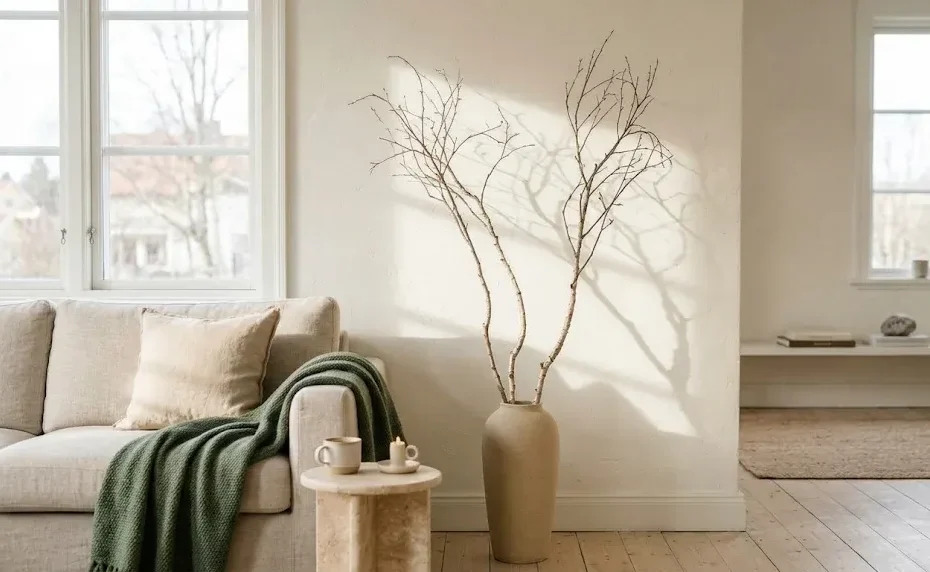
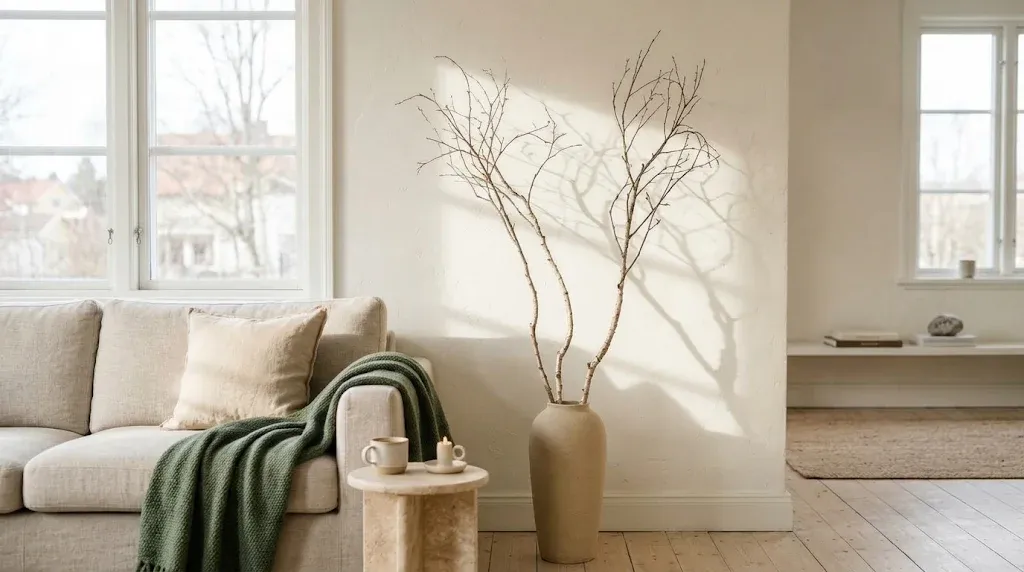
- Living room: one tall, sculptural branch in a stoneware floor vase, placed where it catches afternoon light.
- Dining table: a low, wide bowl with two or three flowering stems—visible but not obstructive.
- Entryway: a single forked branch on a narrow console, with a small ceramic tray beneath it.
- Bedroom: one stem on a dresser. Nothing more.
The restraint is the point. If you’re used to maximalist styling, this will feel like you haven’t finished. Sit with it for a week. The room usually feels calmer, not emptier.
Is Branch Decor Actually Sustainable—or Just Marketing?
It’s sustainable if you source it responsibly, and the stakes are higher now that “natural” has become a selling point.
The sustainable decor market was valued at $410 billion in 2025 and is expected to reach $596 billion by 2032, growing at 5.5% annually. But that growth also means more greenwashing. A branch is not automatically eco-friendly if it’s shipped across continents, dyed with synthetic pigments, or coated in plastic.
Here’s what responsible sourcing looks like:
- Cut from your own garden after pruning, or ask a neighbor or local pruner for offcuts.
- Never cut from public parks or protected trees without permission.
- Ask a florist where stems came from if you’re buying.
- Avoid dyed or plastic-coated branches if compostability matters to you.
- Reuse the same branches across seasons—dried arrangements can last months to years.
The EPA’s waste hierarchy puts source reduction first for a reason: the most sustainable object is the one you don’t need to replace. A well-chosen branch and a durable vase can stay in a room for years, which is the opposite of the seasonal decor cycle.
What Mistakes Make Branch Displays Look Dated or Messy in 2026?
Even a trend-proof idea can go wrong. These are the pitfalls that separate a Lagom-style arrangement from a pile of sticks:
- Too many stems. A crowded vase looks like a bundle. Three is usually enough.
- Wrong height. A branch that stops halfway up a wall looks stranded. Commit to a scale.
- Unstable vessels. A top-heavy display will fall—usually at the worst moment.
- Dirty water. Cloudy water smells and shortens branch life.
- Ignoring the room’s lines. A tall branch can echo a window frame or break up a blank wall. A horizontal branch can work better on a shelf than a vertical one in a low-ceilinged room.
- Over-designing. If it looks engineered, it’s not pyntekvister anymore. It’s a florist arrangement.
The fix is almost always subtraction. Remove one stem, raise the vase, or move the display to a spot where its shape has room to breathe.
How Do You Keep Branches Looking Good for Longer?
Bare branches can last for months if you treat them well. Keep them out of direct sun, which bleaches and dries wood. For dried arrangements, avoid damp rooms—moisture encourages mold. For fresh branches, recut the stems at an angle every week and change the water.
If a branch starts to look tired, don’t throw it out immediately. You can:
- Repurpose it as a structural element in a larger arrangement.
- Hang small ornaments from it for a seasonal shift.
- Paint it with chalk paint for a winter look—though this reduces compostability.
- Move it outdoors to a sheltered spot if it’s still structurally sound.
Part of the appeal of this practice is that the display can evolve. A branch doesn’t have to be “finished” to be useful.
Key Takeaways
- Pyntekvister means decorative branches, and in 2026 it aligns with biophilic demand, Lagom Living, and sustainability expectations.
- Biophilic design searches rose 112% year over year in early 2026—branches are the lowest-barrier way to respond.
- Lagom Living favors warm neutrals, natural materials, and restraint—branch decor fits without effort.
- Forcing branches works reliably if you cut at the right time, keep water clean, and use a cool room.
- Responsible sourcing matters: cut from your own garden or a trusted local source, and avoid dyed or coated stems.
FAQ
What does pyntekvister mean in English?
It translates to “decorative twigs” or “ornamental branches,” from the Norwegian and Danish pynte (to decorate) and kvister (twigs). In practice, it refers to branches arranged indoors for their shape, texture, or seasonal meaning.
Is pyntekvister still trending in 2026?
Yes, and it’s arguably more relevant than before. Biophilic design searches rose 112% year over year in early 2026, and IKEA’s Lagom Living trend favors exactly this kind of restrained natural decor. It’s no longer niche.
What branches are best for indoor arrangements?
Birch and willow for bare structure; forsythia, cherry, crabapple, magnolia, and redbud for forcing. Dried eucalyptus and pussy willow are popular for low-maintenance styling. Choose based on the line you want and the size of your vase.
Can I cut branches from a public park?
No. Cutting from public parks or protected trees is often illegal and damages shared green spaces. Use branches from your own garden, ask a local pruner, or buy from a florist that can tell you where the stems came from.
How long do forced branches take to bloom?
Most easy varieties bloom in two to four weeks, depending on species and when you cut. Forsythia and pussy willow are fastest; magnolia and crabapple can take longer. Branches cut closer to their natural bloom time flower faster.
Do I need special tools for branch decor?
A sharp pair of bypass pruners, a stable vase, and clean water cover most of it. For thick branches, loppers help. A pin holder or a handful of stones keeps stems upright in a wide-mouthed vase. No florist-level toolkit required.
Conclusion
The reason pyntekvister works in 2026 isn’t that it’s trendy. It’s that it’s anti-trendy in the best sense. A branch doesn’t need a seasonal refresh, a supply chain, or a marketing campaign. It needs a vase, some water, and a corner that needed a little life.
If you’re new to this, start absurdly small. One branch. One vase. One spot you’ve been ignoring. The room will tell you whether it wants more. Most of the time, it won’t. That’s the point.