Fanisco in 2026: The AI-Powered Fan Engagement Platform Expanding Beyond Sports

Short Intro
The sports tech world is crowded with apps that promise to “revolutionise” fandom. Most deliver a flashy filter and call it a day. Fanisco—officially Fanisko—is taking a different route. Since 2014, the Chicago-based company has been building the backend plumbing that makes fan engagement actually work: predictions, AR games, loyalty mechanics, and the analytics that prove whether any of it moves the needle.
But 2026 is a pivotal year for the company. New investment, an expanded service portfolio, and a maturing AI market have pushed Fanisco beyond its sports roots. In this guide, you’ll learn what Fanisco does today, how its technology fits into the broader fan engagement boom, and what the latest data says about where the industry is heading.
Quick Overview Box
- What it is: An AI-powered fan engagement and digital solutions platform, founded in 2014.
- Headquarters: Chicago, with operations in Chennai and a global workforce of roughly 50–60 employees.
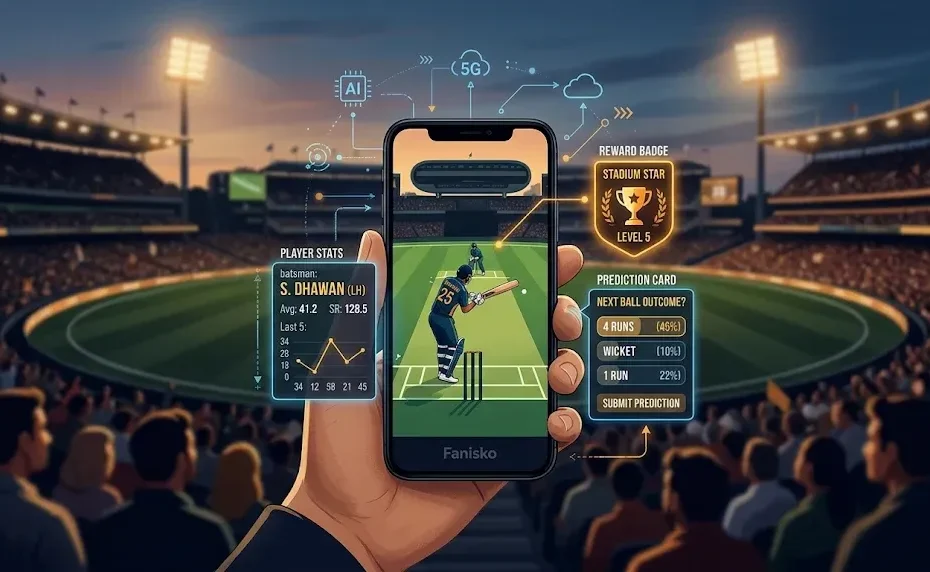
- Core product: Engage by Fanisko—a plug-in layer for team apps that adds predictions, trivia, AR, and rewards.
- Key backers: Karna D. Shinde (technology executive) and Colosseum Sport.
- 2026 pivot: Expanding into generative AI, cloud migration, data engineering, and enterprise XR—not just sports.
What Is Fanisco in 2026?
Definition: Fanisco is a B2B technology company that provides an AI-powered fan engagement platform and a suite of digital transformation services. Its flagship product, Engage, integrates directly into a sports organisation’s existing mobile app to deliver gamification, AR experiences, personalised content, and loyalty mechanics—without requiring the team to build those features from scratch.
The company’s Crunchbase profile describes its platform as an “A.I.-powered backend plugin” that infuses an app with a patent-pending live hybrid fantasy game, personalised feeds, AR and VR gaming, and live play-by-play predictions. That core offering still exists. But Fanisko’s scope has widened considerably.
In 2026, the company also markets services in generative AI, data engineering, cloud computing, cybersecurity, and extended reality (XR) for industries beyond sports—including media, retail, and enterprise clients. It’s no longer just a fan engagement vendor. It’s positioning itself as a broader digital product and solutions firm with sports as its anchor case study.
How the Fanisko Platform Works
Fanisko doesn’t ask fans to download a new app. That’s the first thing to understand. Instead, it operates as a plugin layer inside the team’s existing digital infrastructure.
Here’s the basic flow:
- Integration. Fanisko connects to the team’s app, CRM, and data systems.
- Activation. During live games or off-season periods, the platform pushes predictions, trivia, AR experiences, and challenges to fans.
- Participation. Fans earn points, badges, or rewards for taking part.
- Analytics. The platform feeds behavioural data back to the team—who’s playing, what they respond to, and when they disengage.
The company’s own product page frames it simply: “Engage by Fanisko turns every match into something you don’t just watch—but actually play”. That’s the pitch. The reality is more nuanced. The value isn’t just the games themselves; it’s the data exhaust they generate. A team that knows which fans open the app during the seventh-inning stretch can tailor offers, content, and sponsor messages accordingly.
The 2026 Industry Context: AI Is No Longer Optional
Fanisco’s evolution isn’t happening in a vacuum. The entire sports industry is pouring money into AI and fan engagement—and the numbers explain why.
According to a 2026 industry forecast from Research and Markets, the global AI in sports market was valued at $7.63 billion in 2025** and is projected to reach **$33.32 billion by 2031, growing at a compound annual rate of nearly 28%. A separate analysis from Grand View Research pegs the market at $10.61 billion in 2025**, rising to almost **$50 billion by 2033. The exact figures vary by methodology, but the direction is unambiguous: AI spending in sports is accelerating, not plateauing.
More telling is how executives are actually behaving. Stats Perform’s 2026 Fan Engagement, Monetisation and AI Trends Survey—based on responses from 675 sports media executives worldwide—found that 81% have expanded their use of AI in the past year to gain efficiency and cut costs. The same survey reports that by 2030, respondents expect owned apps and social video platforms to overtake websites as the primary digital fan engagement channels. And while 70% say sponsors now demand more digital content, over a third struggle to find authentic ways to connect sponsors with sport.
That last data point is critical for understanding Fanisko’s opportunity. The platform’s core value proposition—measurable, interactive sponsor activation—sits directly in the gap between what sponsors want and what teams can deliver. According to the Stats Perform 2026 fan engagement survey, the pressure to prove ROI on digital content is intensifying across the industry.
Fanisco’s Funding and Backing: What Changed
For a company founded in 2014, Fanisko has been relatively quiet on the fundraising front. Public records show total disclosed funding of $950,000**, with a reported valuation of around **$6.5 million. But the composition of that backing matters more than the total.
In 2024, Fanisko secured investment from Karna D. Shinde, a technology executive whose backing was framed as fuel for the company’s next growth phase. The stated goal was to expand into generative AI, cloud migration, and data engineering—a clear signal that Fanisko’s future is not confined to AR filters and prediction games. The company has also attracted investment from Colosseum Sport, a sports-focused venture entity.
What does this mean in practice? Fanisko is no longer pitching itself purely as a fan engagement tool. It’s pitching itself as a technology partner for organisations that need help with AI adoption, cloud infrastructure, and immersive experiences—with sports as its proof of concept. That’s a more ambitious (and more competitive) positioning, but it also opens up larger contract values and stickier enterprise relationships. The broader market context supports this move: as the Research and Markets AI in sports forecast shows, the category is expanding fast enough to reward vendors that can serve multiple needs.
Real-World Proof: Cricket, Baseball, and the ICC
Fanisko’s most visible success story remains cricket. Its AR hub for the 2023 ICC Cricket World Cup let fans point their phones at the match and see immersive 3D visuals, real-time player stats, and interactive overlays. The company reported that more than 100,000 fans used the experience within the first three weeks. That project proved the platform could handle a global tournament with a massive audience.
The company’s client and partner list also includes Jio, Lenskart, Tech Mahindra, and EY, according to a panel bio for co-founder and COO Aravind Sampath. The Tech Mahindra relationship, announced in 2020, was framed as a partnership to “revolutionise match viewing experience” through hyper-personalisation and new monetisation models. While that partnership is not new, it established Fanisko’s credibility with large enterprise players—a signal that matters when pitching to leagues and broadcasters.
It’s also worth noting what Fanisko is not claiming. There’s no recent public evidence of a major new client win in 2026, and the company’s own marketing focuses more on capabilities than on named logos. That’s typical for a B2B vendor at this stage, but it means buyers should ask for case studies and retention data during the sales process.
Fanisco vs. the Competition: What’s Different?
The fan engagement space is crowded. Teams can build custom features, buy a point solution, or work with a large consultancy. Here’s how Fanisko’s model compares.
| Feature | Standard team app | Custom-built engagement tool | Fanisko (Engage) |
|---|---|---|---|
| Time to launch | Already live | 6–12 months | Weeks, via plugin |
| AR / VR experiences | Rare | Expensive to build | Built-in |
| Predictive games | Usually absent | Possible, but costly | Patent-pending, ready to deploy |
| Analytics depth | Basic | Varies by vendor | Behavioural + sponsor metrics |
| Off-season engagement | Often dormant | Requires manual content | AI-assisted content generation |
| Upfront cost | Low | Very high | Subscription-based |
| Enterprise services | No | Yes | GenAI, cloud, data engineering |
The trade-off is control. A custom build gives a team total ownership of the code and roadmap. Fanisko offers speed and pre-built features—useful for organisations that want results without a multi-year engineering project. But the company’s expansion into broader enterprise services means it’s now competing with IT consultancies as well as fan engagement specialists. That’s a tougher arena, and it remains to be seen whether Fanisko can win deals on both fronts.
The Challenges Fanisco Must Solve
No platform is without friction. Fanisko faces at least three meaningful hurdles in 2026.
Data privacy. Fan engagement platforms collect behavioural data—what games you play, when you disengage, what rewards you redeem. Teams need to handle that data responsibly, especially across jurisdictions with different privacy laws. Fanisko’s expansion into cybersecurity services suggests the company is aware of this pressure, but awareness isn’t the same as a solution.
App fatigue. Fans already juggle multiple apps for tickets, streaming, news, and social media. Adding another layer of interaction inside an existing app is smarter than launching a new one, but it still competes for attention. The platform’s success depends on whether the games feel like a bonus or a chore.
Proving ROI. Gamification can generate impressive participation numbers. Turning those numbers into ticket sales, merchandise revenue, or sponsor renewals is harder. The Stats Perform data shows that over a third of sports executives struggle to connect sponsors with authentic digital content. If Fanisko can solve that problem with measurable activation data, it has a real differentiator. If it can’t, it’s just another gamification vendor.
What’s Next for Fanisco and Sports Fandom
The next 12 to 18 months will likely reveal whether Fanisko becomes a core layer of the sports app stack or remains a niche tool for teams with big digital budgets.
Three signals are worth watching:
- Generative AI features. If Fanisko can use AI to produce personalised content at scale—recaps, predictions, quizzes—it reduces the manual workload on teams and makes off-season engagement viable. The company has already signalled this direction through its investment narrative.
- Enterprise partnerships. The Tech Mahindra relationship and the Karna Shinde investment suggest Fanisko is positioning itself for larger, more complex deployments. Whether those deployments materialise in sports or in adjacent industries will define its trajectory.
- Retention metrics. The company’s own claims focus on engagement and fan-base growth. If it can publish retention data showing that fans who use its features renew tickets or spend more, the business case becomes much stronger.
For now, Fanisko sits in an interesting middle ground: more capable than a basic app plugin, less expansive than a full digital transformation agency. Its 2026 trajectory suggests it’s trying to close that gap—with AI as the wedge.
Key Takeaways
- Fanisco is now a broader AI and digital solutions firm, not just a sports AR vendor.
- The core product, Engage, plugs into existing team apps to add predictions, AR, and rewards.
- The sports AI market is growing at ~28% annually, and 81% of executives have expanded AI use in the past year.
- Funding is modest but strategic. Karna D. Shinde’s investment is fuelling a pivot toward GenAI and cloud.
- The biggest challenge is proving ROI, not building features. Sponsor activation data is the battleground.
FAQ
What is Fanisco used for?
Fanisco provides a fan engagement platform that plugs into sports teams’ existing apps to add predictions, AR experiences, trivia, and rewards. It also offers broader digital services including generative AI, cloud engineering, and data analytics for sports and enterprise clients.
Is Fanisco the same as Fanisko?
Yes. The company is officially styled Fanisko, but it’s often written as Fanisco. Both refer to the same Chicago-based technology firm founded in 2014.
Which sports organisations use Fanisco?
Publicly referenced clients and partners include the International Cricket Council (ICC), Jio, Lenskart, Tech Mahindra, and EY. The platform is designed for cricket, baseball, football, and other sports with large mobile audiences.
Does Fanisco require fans to download a new app?
No. Fanisko integrates into the team’s existing app as a backend plugin. Fans use the features through the app they already have, which reduces friction and download fatigue.
What makes Fanisco different from other fan engagement tools?
Its combination of AR, predictive games, and analytics in a single plug-in is relatively unusual. It also holds a patent-pending predictive game format and has expanded into enterprise AI services, giving it a broader capability set than pure-play fan engagement vendors.
Is Fanisco free for fans?
Yes. Fans don’t pay to use Fanisko-powered features. The platform is a B2B product; teams and sponsors pay for the engagement layer and analytics.
Conclusion
Fanisco isn’t trying to replace the game. It’s trying to make the space around the game more valuable—the halftime scroll, the off-season lull, the second screen that usually pulls you away from the match.
That’s a harder sell than it sounds. Engagement technology only works when it feels like a bonus, not an obligation. The company’s 2026 pivot toward AI, cloud, and enterprise services is a bet that the same infrastructure that powers a cricket prediction game can power a brand’s entire digital strategy. Whether that bet pays off depends less on the technology and more on whether Fanisko can prove, with hard numbers, that engagement translates into revenue. The market is growing fast enough to reward whoever solves that problem first.