Okfrut: What This Fruit Beverage Brand Really Offers (A Clear, Honest Guide)

Introduction
If you’ve ever stood in a grocery aisle holding a bottle with “fruit” on the label and wondered whether you’re actually holding something healthy, you’re not alone. The beverage world is packed with names that sound natural but deliver something quite different from what you might expect.
Okfrut is one of those names. You may have seen it on a shelf, in a delivery app, or in an online listing, and wondered: Is this juice? Is it a diet drink? Who actually makes it?
This guide answers those questions without the marketing spin. You’ll learn what Okfrut is, who owns the brand, what its products actually contain, and how to decide whether any given bottle belongs in your shopping cart.
Quick Overview: Okfrut at a Glance
- What it is: A fruit-flavored beverage brand, not a fresh juice producer or online fruit store.
- Who owns it: Whole Fruit JPC, a corporation based in San Antonio, Texas.
- Trademark filed: September 16, 2014, with the USPTO (serial number 86981327) .
- Product range: Historical non-carbonated fruit drinks (pineapple, hibiscus, cantaloupe, soursop) and more recent zero-sugar sparkling water lines.
- Nutritional reality: Extremely wide. One historical pineapple drink carried 150 calories and 33 grams of sugar per bottle, while a mango variety listed 0 calories .
- Bottom line: “Fruit-flavored” does not automatically mean healthy. The specific product and its label matter more than the brand name.
What Is Okfrut? Separating Fact From Online Confusion
A Beverage Brand, Not a Fruit Delivery Service
A definition helps here. Okfrut is a trademarked name for a line of fruit-flavored beverages. The United States Patent and Trademark Office record describes the mark as covering “fruit flavored beverages” in the light beverage products category .
That’s a precise legal description, and it matters. It means the brand is about drinks, not about selling whole fruit, delivering produce boxes, or operating as a grocery service. Some online descriptions have blurred those lines, but the trademark record is clear.
The Owner Behind the Name
The trademark is owned by Whole Fruit JPC, a corporation listed at a San Antonio, Texas address . The application was filed in 2014, and the registration was finalized in 2017. The mark remains active, with a Section 8 and 15 filing accepted in September 2023 .
That history tells you something useful: this is an established beverage mark with a documented paper trail, not a fly-by-night label. It also tells you the brand has been around long enough for its product line to shift over time.
The Two Very Different Sides of the Okfrut Product Line
The Original Fruit Drinks: Sweet, Bold, and Sugar-Heavy
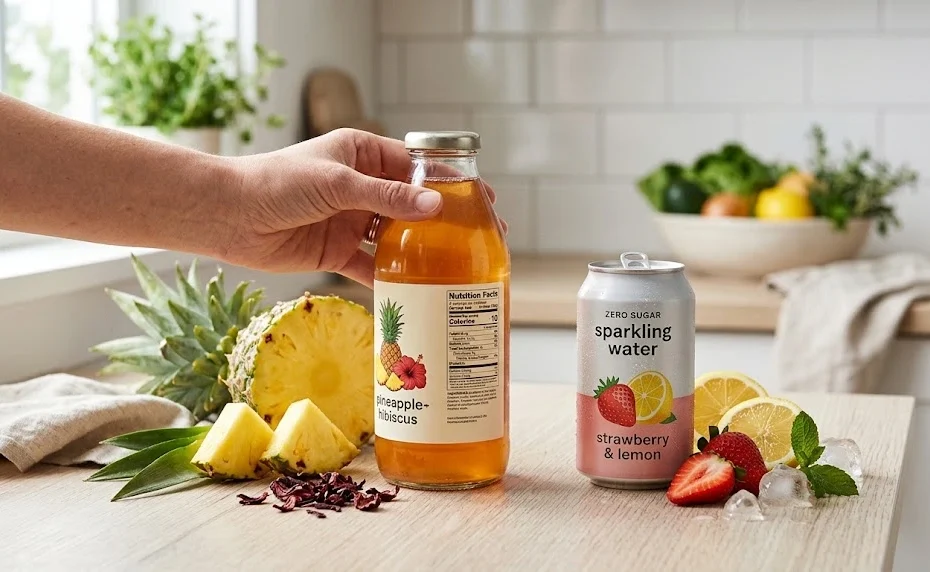
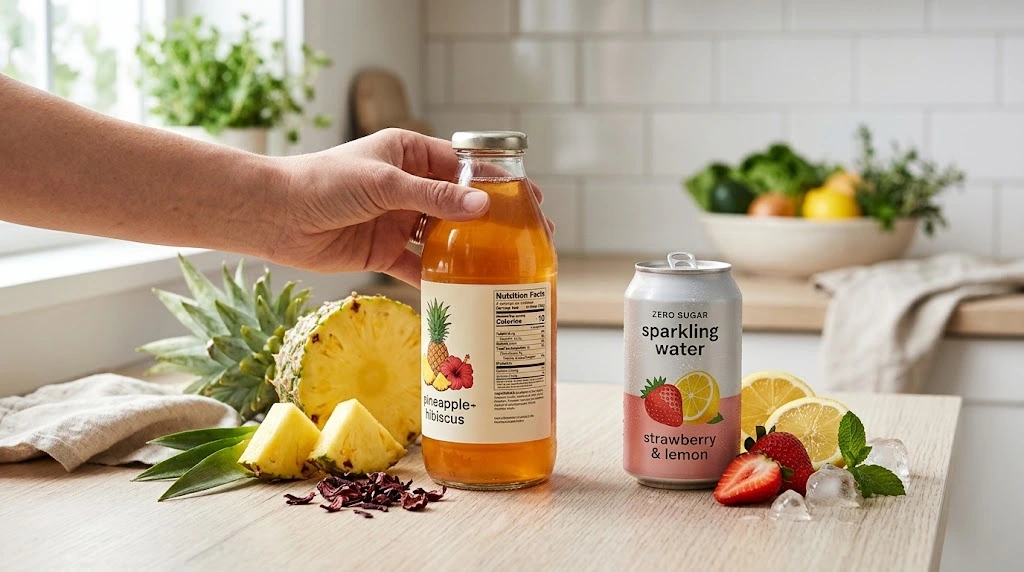
The older Okfrut products are non-carbonated fruit drink waters. They come in flavors like pineapple, hibiscus (jamaica), cantaloupe melon, and soursop .
A 20-fluid-ounce pineapple version lists water, sugar, pineapple juice, citric acid, preservatives, gums, caramel color, artificial flavor, and two yellow food dyes . The nutrition panel tells the rest of the story: 150 calories, 38 grams of carbohydrates, and 33 grams of sugar per bottle .
That is a substantial amount of sugar in a single serving. For context, the World Health Organization recommends that free sugars stay below 10% of total energy intake, with additional health benefits when intake drops below 5% . A drink with 33 grams of sugar easily consumes a large share of that daily allowance.
The Newer Sparkling Waters: Zero Sugar, Zero Calories
More recent Okfrut-adjacent retail listings point to a second direction: zero-sugar sparkling waters in flavors like strawberry and lemon . These products list 0 calories and 0 grams of sugar per serving .
The trade-off is familiar. To get sweetness without sugar, these drinks rely on low-calorie sweeteners. That makes them a very different beverage from the original fruit drinks, even though they sit under the same broad brand umbrella.
Key distinction: Okfrut is not one product. It is a brand name attached to products that sit at opposite ends of the nutrition spectrum. Treating them as interchangeable would be a mistake.
How Okfrut Compares: A Side-by-Side Look
The clearest way to understand the brand is to compare its own products against each other.
| Feature | Original Fruit Drink (Pineapple) | Sparkling Water (Zero Sugar) |
|---|---|---|
| Calories | 150 per bottle | 0 per serving |
| Total Sugar | 33 grams | 0 grams |
| Carbohydrates | 38 grams | 0 grams |
| Sweetener | Sugar (cane/added) | Low-calorie sweeteners |
| Carbonation | Still | Sparkling |
| Best for | Occasional treat | Everyday hydration |
| Label check priority | Very high | Moderate (check sweetener type) |
This table is not a judgment. It is a tool. It shows why a single brand name cannot tell you whether a drink is a sensible daily choice or an occasional indulgence.
The Label Is the Only Reliable Guide (Here’s How to Read It)
Why “Fruit-Flavored” Deserves Scrutiny
Beverage labeling rules allow a drink to be called “fruit-flavored” without containing meaningful amounts of real juice. The flavor can come from concentrates, natural flavors, or artificial flavors. The word “fruit” on the front of a bottle is a marketing signal, not a nutritional guarantee.
This is why the ingredient list matters more than the front label. Ingredients are listed in descending order by weight. If sugar or a syrup appears near the top, the drink is sweetened heavily. If juice appears low on the list, the fruit content is minimal.
The Sugar Math That Actually Matters
Public health guidance gives a concrete benchmark. The NHS advises that adults should have no more than 30 grams of free sugars per day, roughly seven sugar cubes . Children aged 7 to 10 should stay under 24 grams .
Now compare that to the older pineapple Okfrut drink at 33 grams of sugar per bottle . One bottle would exceed an adult’s entire recommended daily free-sugar limit. For a child, it would exceed the limit by a wide margin.
That does not make the drink “bad.” It makes it a drink to treat the way you would treat a soda or a dessert: occasionally, and with awareness.
A Practical Three-Step Label Check
- Look at the sugars line per serving. Ignore the front-of-pack claims until you’ve seen this number.
- Scan the first five ingredients. If sugar, cane sugar, or a syrup is there, expect a sweet drink.
- Check the serving size. A bottle may contain more than one serving, which doubles the numbers you just read.
Who Should Consider Okfrut, and Who Should Skip It?
Good Fits
- Someone looking for a zero-sugar sparkling option who is comfortable with low-calorie sweeteners.
- A shopper who wants a flavored beverage occasionally and is willing to treat the higher-sugar versions as an indulgence rather than a hydration staple.
- A curious consumer who wants to understand what is actually in the bottle before buying.
Poor Fits
- Anyone relying on fruit drinks for daily hydration. Water, plain milk, and unsweetened beverages are better everyday choices.
- Parents looking for a low-sugar drink for young children. The older fruit drinks are high in sugar, and health bodies recommend limiting sugary drinks for children .
- Shoppers assuming “fruit” means “juice.” Okfrut’s core products are fruit-flavored beverages, not 100% juice.
Frequently Asked Questions
Is Okfrut a juice brand?
No. Okfrut is a fruit-flavored beverage brand. Its original products are fruit drink waters, not 100% juice. Some newer listings are zero-sugar sparkling waters. Always check the label for the juice content and ingredient list.
Who owns the Okfrut trademark?
The Okfrut trademark is owned by Whole Fruit JPC, a corporation based in San Antonio, Texas. The application was filed in September 2014, and the registration was finalized in 2017 .
How much sugar is in an Okfrut drink?
It varies dramatically. A 20-fluid-ounce pineapple fruit drink lists 33 grams of sugar and 150 calories per bottle. A mango variety lists 0 calories. The brand’s range is too broad for a single answer .
Are Okfrut sparkling waters healthy?
They are zero-sugar and zero-calorie, which makes them a lower-sugar alternative to the original fruit drinks. However, they contain low-calorie sweeteners. Whether that fits your diet is a personal choice, and the label is the best place to start.
Is Okfrut the same as OKF?
No. Okfrut and OKF are separate brand names. The Okfrut trademark is tied to Whole Fruit JPC in the United States. OKF is a different beverage brand with its own product lines and ownership.
Should I drink Okfrut every day?
For the higher-sugar fruit drinks, no. One bottle can exceed the recommended daily free-sugar limit for an adult . The zero-sugar sparkling versions are a different product and may fit more easily into a daily routine, depending on your preferences.
Key Takeaways
- Okfrut is a beverage brand, not a fresh juice company or fruit delivery service.
- The trademark is owned by Whole Fruit JPC and has been active since 2014.
- The product line spans a huge nutritional range, from 33 grams of sugar per bottle to zero-calorie sparkling waters.
- “Fruit-flavored” is not a health claim. It describes a flavor category, not a nutritional standard.
- The label is your most reliable tool. Check sugars, serving size, and the first five ingredients before you buy.
Conclusion
Okfrut is a useful case study in why brand names alone cannot tell you whether a drink is right for you. The same name sits on a bottle with 33 grams of sugar and on a can with zero calories. Neither is inherently “good” or “bad”—but they serve very different purposes.
The next time you see an Okfrut product, skip the front-of-pack story and go straight to the back. Read the sugars line. Check the serving size. Scan the first five ingredients. That thirty-second habit will tell you more than any marketing claim ever could.