Musicalifornia: A Complete Guide to California’s Music Scene, History, and Culture

Introduction
Think of the Beach Boys’ sun-soaked harmonies, Joni Mitchell’s canyon-crafted lyrics, or Dr. Dre’s G-funk revolution. Each sound carries a distinct California fingerprint. But what exactly makes music from the Golden State so influential—and so endlessly imitated?
Welcome to Musicalifornia: not a single genre, but an ecosystem. It’s a sprawling, diverse musical landscape that stretches from San Diego’s surf breaks to San Francisco’s psychedelic ballrooms to Los Angeles’ endless studio corridors. In this guide, you’ll learn how California’s music evolved, why it matters to the global industry, and how you can experience it firsthand—whether you’re a casual listener, a budding musician, or a culture professional.
Quick Overview Box
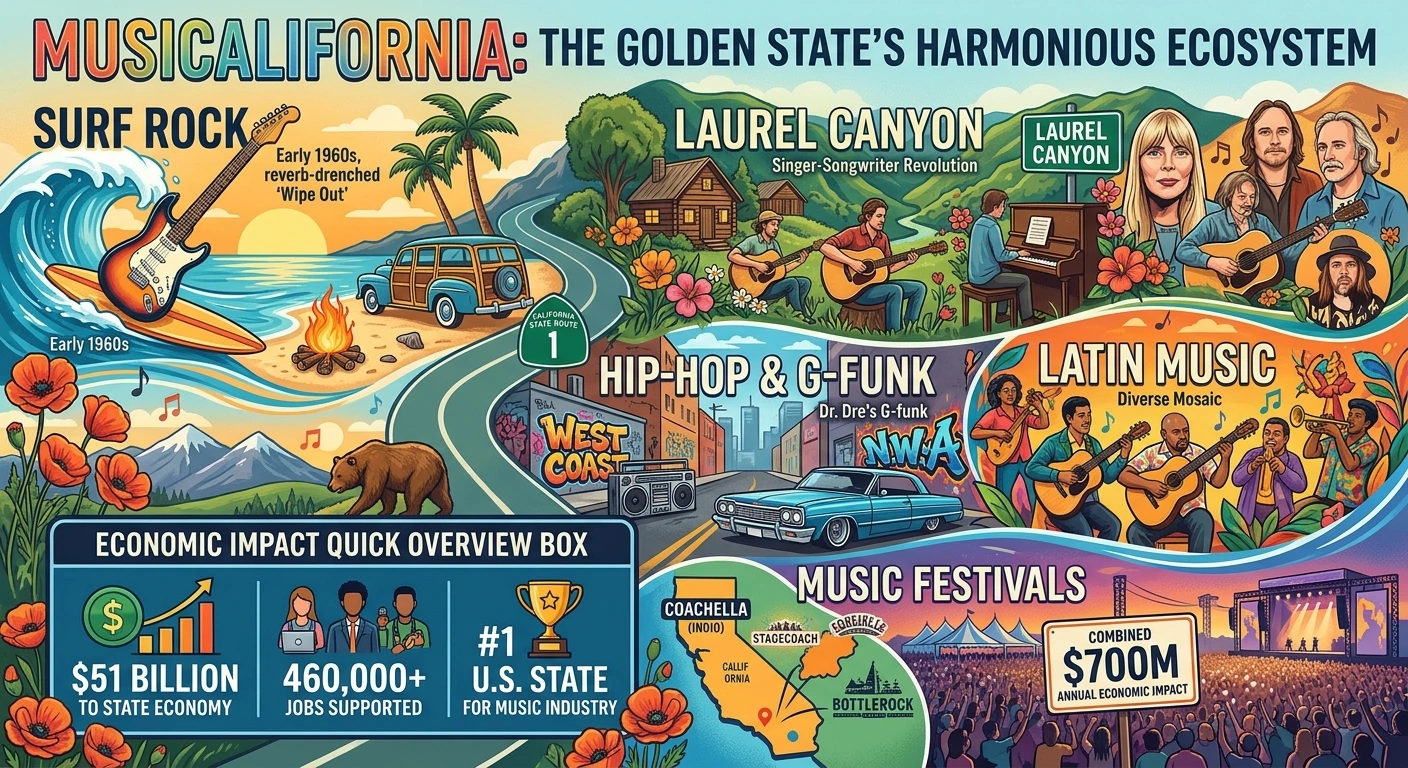
- California’s music industry contributes $51 billion to the state economy and supports over 460,000 jobs.
- Surf rock was the first American music genre to originate in California, emerging in the early 1960s.
- Laurel Canyon in the late 1960s and early 1970s became the epicenter of folk-rock and singer-songwriter culture, producing dozens of landmark hits.
- Festivals like Coachella and Stagecoach generate a combined $700 million annually for the local economy.
- California is the top U.S. state for music industry earnings, employment, and value-added businesses.
What Does “Musicalifornia” Actually Mean?
Definition: Musicalifornia is a cultural shorthand for California’s music ecosystem—a network of artists, genres, institutions, and live events that has produced some of the most commercially successful and creatively influential music in American history.
It’s not a genre you’ll find on a streaming platform. It’s a regional identity that spans surf rock, folk, psychedelia, country, punk, hip-hop, and Latin music. The term captures the idea that California doesn’t just host music—it generates it, exports it, and reinvents it with unusual consistency.
Think of it this way: Nashville is synonymous with country. Detroit is synonymous with Motown. California, however, refuses to be boxed into one sound. That refusal is precisely what makes it the most consequential music state in the country.
The Economic Power Behind California’s Music Scene
Before diving into genres, it’s worth understanding the scale. According to the California Legislature, the music industry contributes $51 billion to the state’s economy and supports more than 460,000 jobs across over 80,000 music establishments. A separate industry report ranked California as the number one state in the nation for music earnings, employment, and business value.
That’s not just good news for record labels. It means touring crews, recording studios, instrument repair shops, venue staff, and thousands of small businesses rely on the state’s musical output. When people talk about the “California dream,” music is a bigger part of that dream than most realize.
So how does a state build such a dominant music economy? It starts with geography, immigration, and a willingness to let different cultures collide. Let’s trace that story.
Surf Rock: The First California Original
In the early 1960s, something new happened on the Southern California coast. A generation of teenagers turned surf culture into a sound—reverb-drenched guitars, driving drums, and wordless vocal harmonies that mimicked the feeling of riding a wave. This was surf rock, and it was the first American music genre to originate in California.
Dick Dale’s “Let’s Go Trippin'” and the Surfaris’ “Wipe Out” became regional hits that quickly spread across the country. The Beach Boys took the formula further, adding lush harmonies and lyrics about cars, girls, and endless summers. Their 1966 album Pet Sounds is now widely considered one of the most important records in pop history.
Why does surf rock matter today? Because it established a template: California could invent a sound, export it globally, and define a lifestyle through music. Every subsequent wave—psychedelia, country-rock, G-funk—followed that same pattern.
Laurel Canyon and the Singer-Songwriter Revolution
If surf rock gave California its first sonic identity, Laurel Canyon gave it a soul. In the late 1960s and early 1970s, an impromptu community of musicians settled in a eucalyptus-scented canyon in the Hollywood Hills. They melded folk, rock, and pop into a sound that conquered the world as thoroughly as the Beatles and the Rolling Stones had before them.
Joni Mitchell, Crosby, Stills & Nash, the Mamas & the Papas, Carole King, the Eagles, and Frank Zappa all lived and collaborated in or around the canyon. The scene was so influential that The Juilliard School now offers a dedicated course exploring its profound impact on American popular music. The course traces how folk, rock, pop, psychedelia, and the emerging singer-songwriter movement converged to reshape popular song.
What made Laurel Canyon different? Intimacy. Musicians lived next door to each other. Songs were written in living rooms, not boardrooms. The result was an era of music that felt personal, experimental, and commercially unstoppable—all at once.
Hip-Hop, Latin Music, and the Diversity of West Coast Sound
California’s musical identity is not frozen in the 1960s. The state has continually absorbed new influences, often from communities that mainstream culture overlooked.
In the late 1980s, West Coast hip-hop exploded out of Los Angeles and the Bay Area. Artists like N.W.A, Tupac Shakur, and Snoop Dogg turned regional stories into global anthems. Producers like Dr. Dre crafted the G-funk sound—slow, synth-heavy beats that became the sonic signature of an era.
At the same time, California’s Latin music scene remained vibrant and commercially vital. The state’s large Mexican population brought traditional folk guitar to California as early as the 19th century. Today, Latin rhythms, Spanish-language radio, and Chicano rock traditions continue to shape the state’s soundscape.
And don’t forget the Bay Area’s thrash metal, San Diego’s punk scene, or the independent artists filling small venues from Sacramento to Long Beach. Musicalifornia is not a monolith. It’s a mosaic—and that’s its greatest strength.
Festivals That Define the Culture
Want to experience Musicalifornia firsthand? The state’s festival calendar is a crash course in its musical range.
These events aren’t just entertainment. They’re economic engines. The California Legislature has formally recognized that music festivals attract visitors, increase sales at local businesses, and create temporary and permanent jobs. For a city like Indio, the Coachella and Stagecoach weekends are the financial equivalent of a small industry.
How California Music Shaped Global Pop Culture
From a historical perspective, few regions have had a comparable impact. California didn’t just produce artists—it produced formats, business models, and cultural aesthetics that the rest of the world adopted.
Laurel Canyon helped birth the album-oriented rock format. West Coast hip-hop made the producer the star. Surf rock turned youth lifestyle into a marketing category. The state’s recording studios, session musicians, and label infrastructure set standards that Nashville, New York, and London often followed.
According to Juilliard’s course on the Laurel Canyon scene, the musicians living in those hills “helped steer American popular music in a new direction during a time of rapid cultural change”. That description could apply to nearly every era of California music. The state has a habit of being early—and being right.
Key Takeaways
- Musicalifornia is an ecosystem, not a genre—it spans surf rock, folk, hip-hop, Latin music, and more.
- California’s music industry contributes $51 billion to the state economy and supports over 460,000 jobs.
- Surf rock was the first California-originated American genre, emerging in the early 1960s.
- Laurel Canyon produced a concentration of musical talent that reshaped global pop in the late 1960s and 1970s.
- Festivals like Coachella and Stagecoach are economic drivers, generating hundreds of millions for local communities.
FAQ
What is “Musicalifornia”?
Musicalifornia is a term used to describe California’s diverse and influential music ecosystem—the artists, genres, institutions, and live events that have shaped American and global popular music for decades. It’s not one style, but a regional identity that spans surf rock, folk, hip-hop, Latin music, and beyond.
What was the first music genre to originate in California?
Surf rock, which emerged in Southern California in the early 1960s. It was the first American music genre to originate in California and the first major style to evolve from the California experience. Dick Dale and the Surfaris were early pioneers.
Why is Laurel Canyon important in music history?
In the late 1960s and early 1970s, Laurel Canyon became home to a tight-knit community of musicians—Joni Mitchell, Crosby, Stills & Nash, the Eagles, and others—who created a body of work that reshaped popular song and helped establish the singer-songwriter movement.
How much does the music industry contribute to California’s economy?
According to the California Legislature, music contributes $51 billion to the state’s economy and supports over 460,000 jobs across more than 80,000 music establishments. California ranks first in the nation for music industry earnings and employment.
Which California festivals have the biggest economic impact?
Coachella and Stagecoach together generate a combined $700 million** for the local economy each year. Aftershock in Sacramento generated an estimated **$35 million in 2025, and BottleRock in Napa reported a $62.7 million total economic impact.
Conclusion
Musicalifornia isn’t a place you can point to on a map. It’s a set of conditions—geography, immigration, risk-taking, and a refusal to stay still—that keeps producing music the world wants to hear. From the first reverb-soaked surf guitar to the latest festival headline set, California has built something rare: a self-replenishing cultural engine.
Whether you’re a listener planning a festival trip, a musician studying the state’s history, or a professional trying to understand the industry’s center of gravity, the lesson is the same. California doesn’t just make music. It makes the conditions for music to matter. And that’s a legacy worth paying attention to.