Miuzo (MU:DS) in 2026: The Museum Brand That Turned Heritage Into a 40 Billion Won Business

TL;DR: Miuzo (MU:DS) is Korea’s national museum merchandise brand—and in 2026 it crossed 41.3 billion won in annual sales, exported to SFMOMA, debuted in Europe at the Milan Olympics, and expanded into Japan. Here’s the fully updated story.
You’ve seen the headlines about K-pop and K-drama. But the quietest Korean cultural export of 2026 might be sitting on someone’s desk right now: a small bronze-toned figure with half-closed eyes, a keyboard painted in temple colors, or a hair clip patterned after an 8th-century bell.
That’s Miuzo—the brand name behind MU:DS, the official merchandise identity of Korea’s National Museum Foundation. And the newest numbers explain why museums around the world are paying attention: 21.8 billion won in the first half of 2026 alone, a 90% jump over the same period last year, with foreign purchases roughly doubling to 1 billion won. This isn’t a souvenir trend. It’s a cultural distribution model that’s now moving through Milan, Tokyo, and San Francisco.
In this updated guide, you’ll get the 2026 numbers, the products driving them, the global moves that matter, and the one tension the brand still has to solve.
Quick Overview: Miuzo (MU:DS) at a Glance
- What it is: The National Museum Foundation of Korea’s unified cultural merchandise brand, launched in 2022.
- 2025 annual sales: 41.337 billion won, up 94.2% from 2024’s 21.284 billion won.
- First-half 2026 sales: 21.8 billion won, already surpassing all of 2024.
- Through September 2026: 35.044 billion won, reaching 84.8% of the previous full year.
- Flagship product: The Pensive Bodhisattva miniature—over 60,000 cumulative units, with 12,000 sold in H1 2026.
- Global footprint: Milan Winter Olympics Korea House (Europe debut), Tokyo National Museum (Japan debut), and SFMOMA (largest single overseas museum export at $110,000).
What Is Miuzo—and Why Is It Suddenly Everywhere?
Definition: Miuzo (MU:DS) is the National Museum Foundation of Korea’s official brand for cultural products. It transforms artifacts from the National Museum of Korea and regional national museums into contemporary stationery, accessories, home goods, and fashion items designed for daily use.
The name is a portmanteau: MU from museum, DS from goods. But the brand’s real innovation isn’t the name. It’s the design brief.
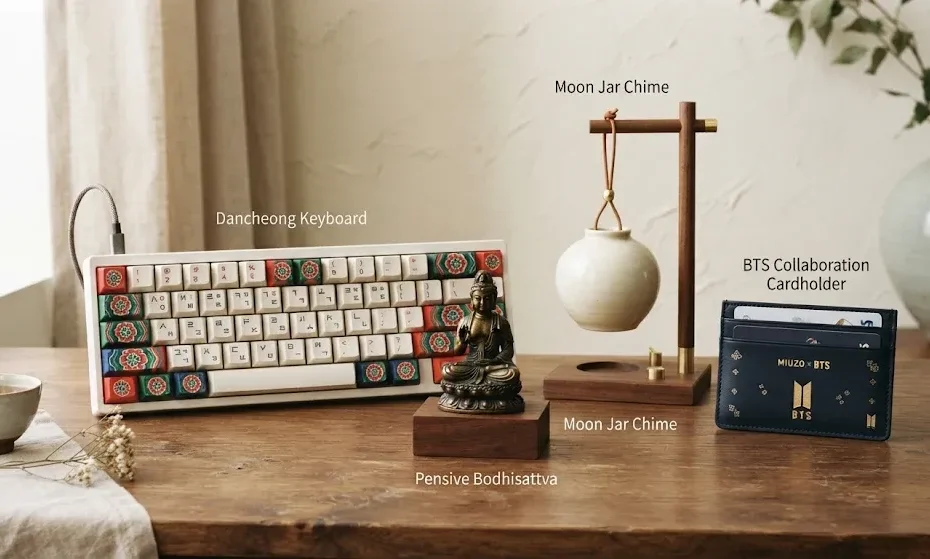
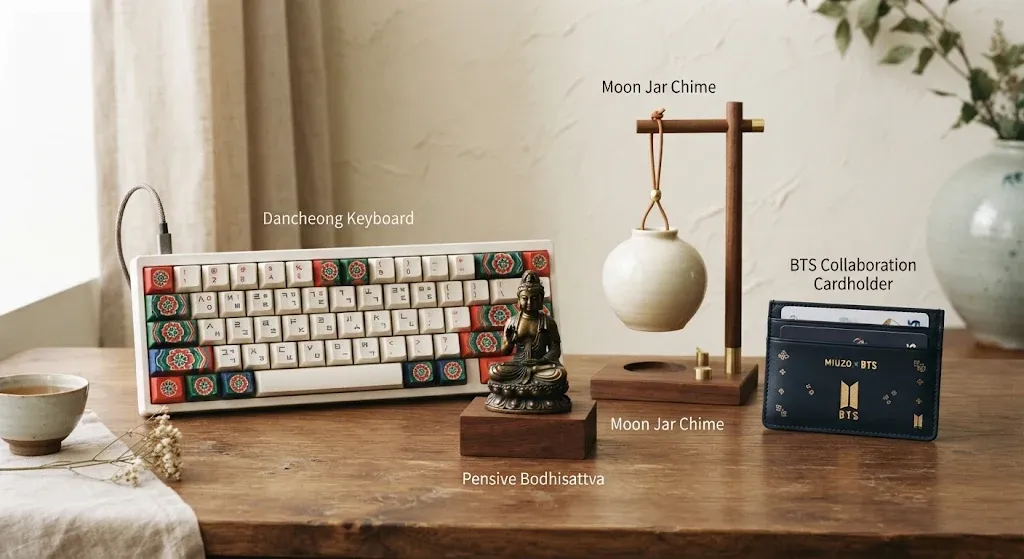
Traditional museum shops often reproduce an object at a smaller scale and stop there. Miuzo starts with a motif—a celadon glaze, a dancheong pattern, the silhouette of a moon jar—and asks what that reference would look like as something you actually reach for. A dancheong keyboard. A moon-jar door chime. A wine stopper shaped after Admiral Yi Sun-sin. The heritage is the starting point, not the final product.
That approach has turned the gift shop from an afterthought into a destination. At the National Museum of Korea in Yongsan, “open runs”—visitors rushing to the Miuzo shop the moment the museum opens—have become a familiar scene. The foundation’s product business head, Kim Mikyung, told The Asia Business Daily that the shop was once “an optional souvenir shop that could easily be skipped.” Now it’s the first stop for many visitors.
The 2026 Numbers: Growth That Doesn’t Look Like a Fad
The sales curve tells a clearer story than any single product launch.
| Year | Annual Sales (won) | Change |
|---|---|---|
| 2022 | 11.69 billion | First year as unified brand |
| 2024 | 21.28 billion | — |
| 2025 | 41.34 billion | +94.2% |
| 2026 (Jan–Sep) | 35.04 billion | 84.8% of 2025 total |
Data source: National Museum Foundation of Korea, via ZDNet Korea.
Two details stand out. First, the first-half 2026 figure of 21.8 billion won was the first time the brand crossed 20 billion won in a half-year period since the foundation was established in 2004. Second, foreign purchases in that half-year reached about 1 billion won, roughly double the prior year—a signal that the brand is no longer relying only on domestic museum foot traffic.
According to Yonhap News Agency’s July 2026 report on the brand’s record half-year, the surge has been fueled by rising museum attendance and the global visibility of a single product: the Pensive Bodhisattva miniature.
The Product That Changed Everything: The Pensive Bodhisattva Miniature
Every brand has a gateway object. For Miuzo, it’s a small replica of the Gilt-bronze Pensive Bodhisattva—a National Treasure of Korea depicting a seated figure with half-closed eyes and a faint smile, lost in thought.
The object has sold over 60,000 units cumulatively, including about 12,000 in the first half of 2026 alone. Its cultural reach expanded beyond museum walls when BTS leader RM was reported to own two of them. Then, in February 2026, President Lee Jae-myung and First Lady Kim Hee-kyung visited the museum and posed with the miniature, making a finger-heart gesture.
Why does this particular object resonate? It’s not ornate. It doesn’t shout its history. The figure’s expression reads as contemplation, rest, or quiet reassurance—qualities that translate across languages and generations. Buyers describe it as a gift for someone going through a difficult time, or a small anchor for their own desk.
The miniature’s cumulative revenue has reached 30.52 billion won, according to foundation data reported by ZDNet Korea. It is, in practical terms, the brand’s economic engine.
Beyond the Miniature: The Products Defining Miuzo in 2026
The Pensive Bodhisattva opened the door. The catalogue kept people inside.
Here are the 2026 standouts:
- The “Drunken Scholar” color-changing cup set. Pour a cold drink and the scholar’s face blushes. It has generated 41.86 billion won in cumulative revenue—the highest of any single Miuzo product line.
- The 2026 Miuzo contest winners. The foundation’s annual open call produced sold-out hits: a national seal keycap keyring (38,000 won, restocked August 6 with a three-per-person limit), a Geumgangsan saekdong air (25,000 won, restocked August 7), and a gat umbrella (43,000 won, sold out).
- The dancheong keyboard. Traditional temple-eave painting applied to a modern computer keyboard—a product that has become a visual shorthand for the brand’s design philosophy.
- The Yi Sun-sin wine stopper. A historical figure turned into a functional dinner-table object, released alongside a special exhibition.
- The BTS Dalmajung collaborations. Multiple collections since 2021, each reinterpreting a national treasure through the lens of BTS’s lyrics and graphics.
The common thread: none of these are display objects. They are things people use. That’s the design brief, and it’s why the brand has moved beyond the “gift shop” category.
The BTS and RM Effect: Fandom as a Doorway to Heritage
Miuzo’s global visibility in 2026 is inseparable from BTS—but the relationship is more deliberate than a typical celebrity merch drop.
In March 2026, the foundation and HYBE released the “2026 BTS x MU:DS Collaboration,” reinterpreting the Divine Bell of King Seongdeok—the 18.9-ton bronze bell cast in 771 and housed at Gyeongju National Museum. The collection translated the bell’s vine and lotus motifs, celestial offering figures, and cloud patterns into five items: a shoulder bag, hairpin, hair clip, cardholder, and layered skirt.
According to The Korea Times coverage of the BTS and MU:DS collaboration, the foundation’s CEO, Choung Yong-suk, framed the collection as a way to bring “the beauty of ancient Korean craftsmanship” to global audiences who already love BTS.
The more commercially significant BTS connection came through RM’s individual collaboration with SFMOMA. The exhibition RM x SFMOMA: Between You and Me runs until February 7, 2027, and Miuzo supplied 39 product types worth approximately **$110,000**—the foundation’s **largest single overseas museum export to date**, about **71% higher** than the combined total of its two previous Smithsonian exports ($64,000).
That number matters for a reason beyond revenue. It shows that a K-pop fandom can function as a distribution channel for cultural heritage—not by diluting the heritage, but by giving global audiences a familiar entry point.
Global Expansion: Milan, Tokyo, and the Museum Shelf
Miuzo’s 2026 expansion followed a clear sequence: visibility first, then institutional credibility, then retail.
Milan (February 2026). The brand made its official European debut at the Milan-Cortina Winter Olympics Korea House, presenting 96 product types across five themes and selling 19 popular items on-site. It was the first time Miuzo had entered Europe under its own name, and the setting—design capital, global media spotlight—was intentional.
Tokyo (February–April 2026). Miuzo entered the Tokyo National Museum in conjunction with the special exhibition Treasures of Korean Art from the National Museum of Korea, marking the 60th anniversary of Japan-Korea diplomatic normalization. The lineup included 24 products—celadon plate sets, handkerchiefs, pouches, bags, and keyrings—chosen for practicality and Japanese preferences. This was the foundation’s second official overseas museum export, following the Smithsonian.
San Francisco (October 2026–February 2027). The SFMOMA export, tied to RM’s exhibition, became the largest single overseas museum order in Miuzo’s history.
The pattern is not random pop-up tourism. It’s a museum-to-museum strategy: place Miuzo products in trusted cultural retail environments, let the design speak, and build demand from there.
What Miuzo’s Success Means for Cultural Institutions
The financial results are impressive. The more interesting question is what Miuzo proves about heritage branding.
A comparison helps: A traditional museum souvenir says “You visited.” A Miuzo product says “You live with this.” The first commemorates an experience. The second creates an ongoing relationship with an object and, by extension, with the collection it references.
That shift has consequences. The foundation has been careful to frame the brand as a “K-culture distribution platform,” not a gift shop. Products are planned around significance, rarity, and aesthetics, with internal and external verification to avoid distorting the artifact’s meaning. The team studies with curators before a motif becomes a product.
The demographic data suggests the strategy is broadening the audience. At the National Museum of Korea’s product shop, buyers in their 40s rose from 17.0% in 2024 to 34.3% by September 2026, while buyers 50 and older grew from 11.9% to 18.2%. This is not a youth-only fandom story. It’s a design story that happens to have a fandom tailwind.
The Tension Miuzo Still Has to Solve
A ranking-worthy article doesn’t ignore the difficult parts. Miuzo’s growth has also exposed structural questions.
In 2026, the foundation faced National Assembly audit scrutiny over the commission rates charged to consignment suppliers. Rates ranged from 15% to 50%, and 99 of 419 suppliers were subject to rates of 40% or higher. Critics argued that because commission rates account for 20% of the supplier selection score, vendors might feel pressure to propose higher rates to win shelf space.
The foundation’s position is that suppliers set their own prices and commission rates, and that it does not unilaterally impose terms. Industry observers note that Miuzo often selects products that suppliers already make for other retailers, rather than commissioning exclusive goods.
Separately, a design rights dispute has emerged over merchandise motifs derived from national heritage, raising questions about how much of a cultural artifact can be exclusively claimed by a single vendor.
These are not signs of failure. They are signs of a brand that has become large enough to require governance. The next phase of Miuzo’s story will be as much about fair partnership as it is about design.
How to Experience Miuzo in 2026–2027
If you want to see the brand in person or online, here’s the practical map:
- Seoul: The National Museum of Korea’s Miuzo shop carries the broadest selection, including the Pensive Bodhisattva miniature and rotating exhibition-specific items. Expect “open run” behavior for limited drops.
- Regional national museums: The “regional heritage collection” extends Miuzo products to artifacts held outside Seoul, giving local museums their own design identity.
- Tokyo: The Tokyo National Museum’s special exhibition runs through April 5, 2026; Miuzo products are available in the museum shop.
- San Francisco: SFMOMA carries Miuzo products in connection with RM x SFMOMA through February 7, 2027.
- Online: The foundation’s official channels and Weverse for BTS collaboration drops. Popular items sell out quickly; restocks are announced on the foundation’s notice board.
A practical tip: if an item is sold out online, the physical museum shop may still have inventory. Distribution between channels is uneven, and restocks tend to cycle.
Key Takeaways
- Miuzo (MU:DS) is the National Museum Foundation of Korea’s unified cultural merchandise brand, launched in 2022.
- 2025 annual sales reached 41.337 billion won (+94.2%); first-half 2026 hit 21.8 billion won (+90%), already surpassing all of 2024.
- The Pensive Bodhisattva miniature is the flagship, with 60,000+ cumulative units and 30.52 billion won in cumulative revenue.
- Global expansion in 2026 includes the Milan Olympics Korea House (Europe debut), Tokyo National Museum (Japan debut), and SFMOMA (largest single overseas export at $110,000).
- The brand’s model—heritage as usable design—has broadened its buyer base, with 40-something buyers rising from 17% to 34.3% of shop purchases.
- The next challenge is governance: commission-rate scrutiny and design-rights disputes are now part of the growth story.
FAQ
What does Miuzo (MU:DS) stand for?
Miuzo combines “museum” and “goods.” It is the National Museum Foundation of Korea’s official brand for cultural products that reinterpret national treasures as contemporary items for daily use, rather than display-only souvenirs.
How much did Miuzo sell in 2026?
In the first half of 2026, Miuzo recorded 21.8 billion won in sales, up about 90% year-over-year. Through September 2026, sales reached 35.044 billion won, already 84.8% of the previous full year’s total.
What is Miuzo’s best-selling product?
The Pensive Bodhisattva miniature is the flagship, with over 60,000 units sold cumulatively. The “Drunken Scholar” color-changing cup set has generated the highest cumulative revenue at 41.86 billion won.
Has Miuzo collaborated with BTS?
Yes. The foundation and HYBE have released multiple “BTS Dalmajung × MU:DS” collections since 2021. The 2026 collection reinterpreted the Divine Bell of King Seongdeok into five modern items. Separately, Miuzo supplied $110,000 in products to SFMOMA for RM’s 2026–2027 exhibition.
Where can I buy Miuzo products outside Korea?
As of late 2026, Miuzo has official retail presence at the Tokyo National Museum (through April 2026) and SFMOMA (through February 2027), following earlier Smithsonian placements. The foundation continues to pursue museum-to-museum exports.
Why is Miuzo getting attention from cultural institutions?
Because it demonstrates that heritage merchandise can be design-led, commercially viable, and globally portable without reducing artifacts to novelty items. Its museum-to-museum export model offers a case study for institutions trying to extend their reach beyond physical visitors.
Conclusion
Miuzo’s 2026 story is not really about museum merch getting popular. It’s about a shift in what cultural institutions send out into the world—and what people are willing to keep.
The brand has found a balance that few museum shops manage: objects useful enough to live with, beautiful enough to display, and rooted enough to carry meaning. The numbers confirm the demand. The global moves confirm the model. The tensions confirm that the model now matters enough to scrutinize.
Whether you encounter Miuzo through a BTS collaboration, a museum visit, or a gift from someone who thought you’d like the quiet figure with half-closed eyes, the effect is the same: the distance between the gallery and daily life gets a little shorter.