Intelligent Putty in 2026: The Updated Guide to Smart Materials, Self-Healing Skins, and What’s Actually New

Introduction
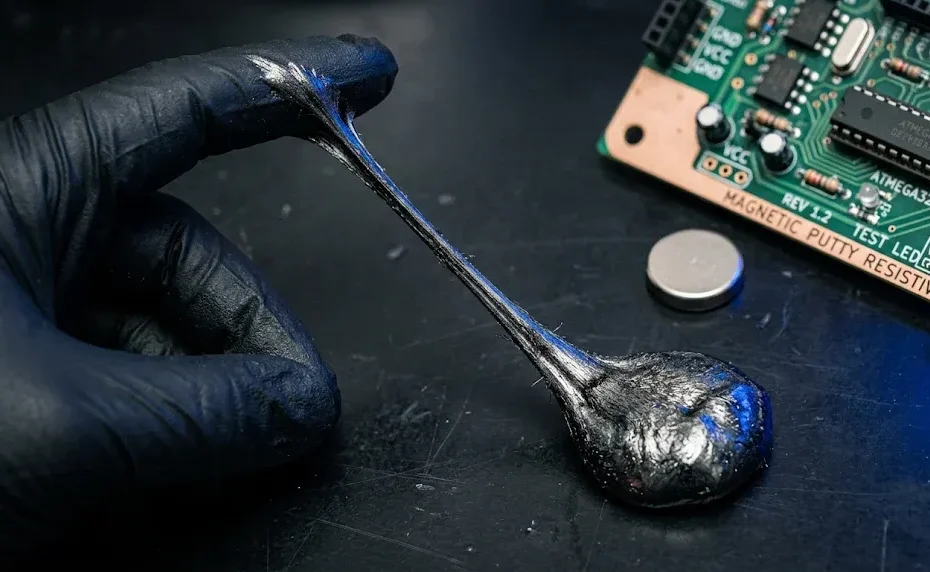
The putty sitting in a tin on your desk and the putty being studied in robotics labs are, chemically speaking, close cousins. Both are viscoelastic silicone polymers—materials that flow like a liquid under slow force and resist or bounce like a solid under sudden force. That dual personality is what makes them fun to squish.
But between 2025 and 2026, the research has accelerated in ways that matter beyond novelty. Self-healing permanent magnet putty now recovers 90% of its mechanical strength in ten seconds after being cut clean through. Liquid-metal composite putties stretch to 1,560% their original length while maintaining stable electrical resistance. Graphene-doped putty can detect deformations with a sensitivity that rivals dedicated strain sensors.
This updated guide is for anyone who wants the real, current picture—whether you’re a curious beginner, a parent checking safety, or a professional tracking soft-materials research. You’ll get the newest peer-reviewed findings, honest comparisons, and practical guidance that hasn’t been recycled from five-year-old blog posts.
Quick Overview Box: What’s New in 2025–2026
- Permanent Magnet Putty (PMP) self-heals 90% of mechanical strength in 10 seconds and recovers magnetic function within 20 minutes Advanced Robotics Research, 2025.
- G-putty with graphene achieves a gauge factor above 500, making it one of the most sensitive soft strain sensors reported Micro and Nano Systems Letters, 2025.
- Liquid metal composite putty reaches 1,560% fracture strain and retains EMI shielding at 600% strain Composites Part B, 2026.
- Commercial intelligent putty remains non-toxic and water-free, but magnetic varieties still require strict supervision for children under 8.
- The gap is widening between consumer “smart putty” and lab-grade functional putty—they share chemistry but serve completely different purposes.
What Is Intelligent Putty, Really?
Definition: Intelligent putty is a non-Newtonian, viscoelastic polymer—typically polydimethylsiloxane (PDMS) cross-linked with boron—that flows under low stress, resists or bounces under high stress, and contains no water, so it never dries out.
The word “intelligent” gets used loosely. In consumer marketing, it signals sensory effects: magnetic attraction, color change, glow, or UV reactivity. In materials science, it signals functional responsiveness—the ability to sense deformation, heal damage, or change stiffness on command.
Those are not the same claim. A color-changing putty is “smart” in a playful sense. A putty that restores its electrical conductivity after being severed is smart in an engineering sense. Both are legitimate, but only one is currently reshaping robotics research.
How Does the Newest Research Change the Picture?
The most significant shift since 2025 is that putty has become a platform material—a base chemistry that researchers modify with particles, liquids, and networks to produce specific functions.
Self-Healing Permanent Magnet Putty (PMP)
Published in Advanced Robotics Research in late 2025, PMP integrates high-coercivity NdFeB microparticles into a dynamic polyborosiloxane–Ecoflex matrix. The result is a material that behaves as both a structural skin and a magnetic sensor.
The recovery numbers are the headline: 90% mechanical strength recovery within 10 seconds after complete cutting, 70% structural recovery from small deformations within 20 minutes, and 80% recovery of magnetic amplitude and response within the same window. As a robotic skin, it detects forces in the 5–30 N range and exhibits roughly twice the magnetic sensitivity of commercial magnetic putties.
Perhaps most importantly for real-world robotics, PMP can distinguish between pressing and cutting—a safety function that matters for medical and industrial robots operating near humans.
G-Putty: Graphene Makes It a Sensor
G-putty works on a different principle. Conductive graphene flakes are mixed into a soft silicone matrix at just enough concentration to form a percolating network—the “tipping point” where electricity can suddenly travel across the material.
When you stretch or press the putty, the flakes shift, contacts break and reform, and the electrical resistance changes in a measurable way. Near the percolation threshold, small motions produce large signal changes. A 2025 review in Micro and Nano Systems Letters notes that G-putty exhibits a gauge factor surpassing 500, placing it among the most sensitive soft strain sensors.
The catch, as the FunsizePhysics team explains, is that the signal depends not only on how much you deform the putty but also on how fast you do it—because the material itself is viscoelastic. That complexity is both a challenge and an opportunity for sensor design.
Liquid Metal Composite Putty: Stretch, Shield, and Stealth
A 2026 paper in Composites Part B introduced a graphene-oxide-modified liquid metal composite putty that pushes stretchability and multifunctionality much further.
The material achieves an ultra-high fracture strain of 1,560% and maintains a stable resistance of about 0.2 Ω across 0–700% strain. Even at 600% strain, it retains high conductivity and effective electromagnetic interference (EMI) shielding of 19.4 dB. It also exhibits temperature-responsive rigidity—stiff at −10 °C, flexible at 30 °C—and low thermal conductivity, enabling dual-spectrum stealth in microwave and infrared bands.
This is not a toy formulation. It’s a candidate material for adaptive flexible electronics and multispectral stealth technology.
What Types of Intelligent Putty Can You Actually Buy?
Commercial putty has not changed as dramatically as the research, but the category has matured. The table below reflects what’s generally available from established sensory-putty brands as of late 2026.
| Type | Key Feature | Best For | Age Guidance |
|---|---|---|---|
| Classic | Smooth stretch and bounce, water-free | Stress relief, fidgeting, classroom demos | 4+ |
| Magnetic | Iron particles; attracted to strong magnets | Science demonstrations, visual experiments | 8+ (magnet safety) |
| Heat-sensitive | Color changes with hand warmth | Sensory play, visual engagement | 4+ |
| Glow-in-the-dark | Charges under light, glows later | Nighttime play, calm-down corners | 4+ |
| UV-reactive | Changes under blacklight | Parties, sensory rooms | 4+ |
| Metallic / effect | Pearlescent or shimmer finishes | Aesthetic play, collectors | 4+ |
Magnetic varieties remain the most functionally distinct consumer option. They’re genuinely entertaining—the putty appears to “crawl” toward a magnet—and they double as a hands-on lesson in magnetic fields. But they also carry the strictest safety requirements, which the next section covers.
Is Intelligent Putty Safe? The Updated Picture
For standard, non-magnetic intelligent putty, the safety profile has not changed: reputable brands use non-toxic silicone and are typically free of latex, gluten, and phthalates. Most are labeled for ages 4 and up.
The exception remains magnetic putty. Small neodymium magnets pose a serious ingestion hazard. If multiple magnets are swallowed, they can attract each other across intestinal walls and cause tissue damage. Magnetic putty should be kept away from children under 8 and stored securely.
A few practical cautions apply across all types, and they’re worth repeating because they haven’t changed:
- Fabric and hair: Putty bonds to fibers and is difficult to remove once embedded.
- Pets: Ingestion can cause intestinal blockages. Store tins out of reach.
- Heat: Direct sunlight or hot surfaces can degrade the polymer over time, even though the material doesn’t “dry out” in the conventional sense.
One updated note: as lab-grade formulations incorporate metal particles and liquid metals, the safety conversation for research materials is different from consumer products. Gallium-based liquid metals, for example, are biocompatible in some formulations but require careful handling in bulk. That distinction matters if you’re reading a research paper and assuming the same rules apply to a toy tin.
How Does Intelligent Putty Compare to Silly Putty and Therapy Putty?
The three materials are often lumped together, but they serve different purposes and have different performance profiles.
| Feature | Intelligent Putty | Silly Putty | Therapy Putty |
|---|---|---|---|
| Primary purpose | Sensory play, fidgeting, science demos | Novelty toy | Hand rehabilitation |
| Base chemistry | Silicone polymer (PDMS) with boron cross-links | Silicone polymer (similar) | Silicone or putty blends, graded resistance |
| Dries out? | No (water-free) | Generally no | Varies |
| Special effects | Magnetic, thermal, glow, UV, metallic | Limited | None |
| Resistance grading | Not graded | Not graded | Color-coded by resistance level |
| Clinical use | Not a substitute for therapy | No | Yes, prescribed by OTs |
The key distinction is intent and specification. Therapy putty is a clinical tool with defined resistance grades. Silly Putty is a historical novelty. Intelligent putty is a broad category that spans sensory play, education, and—in lab formulations—functional materials research.
What Are the Real-World Applications Beyond the Toy Aisle?
The 2025–2026 research points toward several concrete application areas, some closer to deployment than others.
Soft Robotic Skins and Self-Healing Interfaces
PMP is explicitly designed as a robotic skin—a conformable, self-repairing layer that can sense force and magnetic fields without rigid components. Because it recovers mechanically in seconds and magnetically in minutes, a robot equipped with a PMP skin could sustain surface damage and continue operating without manual repair.
Carnegie Mellon’s Soft Machines Lab is pursuing a related vision: soft robots that heal their own severed circuits, drawing inspiration from nerve regeneration. The materials differ, but the design philosophy is the same—embed sensing and repair functions directly into the material rather than bolting them on.
Wearable Strain and Pressure Sensors
G-putty’s deformation-sensitive resistance makes it a natural candidate for wearable sensors that conform to skin or fabric. Research has demonstrated its use for motion monitoring and vital-sign sensing, and its gauge factor above 500 puts it in a competitive range for soft strain sensing.
The barriers to commercialization are practical: long-term stability, repeatability over thousands of cycles, and manufacturing consistency. As one 2025 commentary noted, proving mass-producibility and long-term performance are the key hurdles before G-putty moves from lab to product.
Adaptive Electromagnetic and Thermal Management
The liquid metal composite putty’s combination of high conductivity, EMI shielding, and thermal insulation opens applications in flexible electronics that need to manage both electromagnetic interference and heat. Its temperature-responsive rigidity adds a programmable dimension—the same material can be stiff at one temperature and flexible at another, which is useful for adaptive structures.
Reconfigurable Magnetic Robotics
Beyond PMP, separate work on magnetic putty as a robotic material has shown that viscoelastic magnetic composites can be shaped in 3D, self-heal mechanical damage, and assemble parts without adhesives. Researchers have demonstrated reconfigurable magnetic setups, shapable magnets with adaptive polarities, and growing bioinspired structures. The accessibility of the material makes it a useful prototyping and educational tool for soft robotics.
How Should You Care for Intelligent Putty in 2026?
The care instructions haven’t changed dramatically, but the reasoning behind them is worth understanding.
Store it in its container. Gravity is relentless. Left out, putty flattens and collects dust, lint, and hair. Once debris is trapped in the polymer matrix, it’s nearly impossible to remove completely.
Keep hands clean before use. Lotion, food residue, and dust degrade the sensory experience and contaminate the material.
Warm it with your hands, not a heater. A few seconds of kneading increases pliability. Direct heat can alter the polymer over time.
Avoid washing with water. The material is hydrophobic and water-free. Introducing water doesn’t “clean” it in any useful sense.
Keep magnetic varieties away from electronics and cards. Strong neodymium magnets can damage magnetic stripe cards, mechanical watches, and sensitive devices.
Key Takeaways
- Intelligent putty is a platform chemistry, not a single product. The same viscoelastic silicone base supports consumer sensory toys and lab-grade functional materials.
- The newest peer-reviewed breakthrough is permanent magnet putty (PMP), which self-heals 90% of mechanical strength in 10 seconds and enables force sensing in the 5–30 N range for robotic skins.
- G-putty uses graphene’s percolation network to convert deformation into electrical signals, with a gauge factor above 500—but long-term stability remains a commercialization barrier.
- Liquid metal composite putty pushes stretchability past 1,500% while maintaining EMI shielding, pointing toward adaptive flexible electronics.
- Consumer safety fundamentals are unchanged: standard putty is non-toxic and water-free; magnetic putty requires strict supervision for young children.
FAQ
What is the newest type of intelligent putty in 2026?
The most significant recent development is permanent magnet putty (PMP), a self-healing composite that restores 90% of its mechanical strength within 10 seconds of being cut. It’s a research material, not a consumer product, and is designed for soft robotic skins with force and magnetic sensing.
Is intelligent putty the same as G-putty?
Not exactly. G-putty is a specific formulation that adds graphene to a silicone putty base to make it electrically conductive and deformation-sensitive. “Intelligent putty” is a broader category that includes G-putty, magnetic putty, thermal putty, and other functional variants.
Does intelligent putty ever dry out?
No. It contains no water, so it doesn’t evaporate or harden the way water-based slimes do. Stored in its tin, a quality putty can remain usable for years. The main degradation pathway is contamination with dust and lint, not drying.
Can intelligent putty be used for hand therapy?
It should not replace therapy putty, which is graded by resistance and prescribed by occupational therapists. Intelligent putty is designed for sensory play and fidgeting. If you need graded resistance for rehabilitation, use a clinical product.
Why is magnetic putty considered more hazardous?
Magnetic putty contains small, strong neodymium magnets or magnetizable particles. If swallowed, multiple magnets can attract each other across intestinal walls and cause serious injury. It is generally recommended for ages 8 and up, with adult supervision.
Is the graphene in G-putty safe to handle?
In the concentrations used in research formulations, graphene is embedded within the polymer matrix. Handling the composite is different from handling loose graphene powder. Consumer products that use graphene or similar conductive fillers should be evaluated on a case-by-case basis, following the manufacturer’s guidance.
Conclusion
The story of intelligent putty in 2026 is a story of convergence. A material that began as a failed rubber substitute and became a bestselling toy is now being reformulated into self-healing robot skins, wearable sensors, and adaptive electromagnetic shields.
The toy tin and the research preprint are not the same thing—and that’s the point. Understanding the difference between marketing “smart” and engineering “smart” is the first step toward using the material well, whether you’re squishing it for stress relief or reading a paper on percolation thresholds.
The next time you stretch a strand and watch it snap, remember: somewhere in a lab, a version of that same snap is being measured, modeled, and engineered into a material that can heal itself in ten seconds.