EasyJet Flight U2238 Emergency Landing Newcastle: What Really Happened

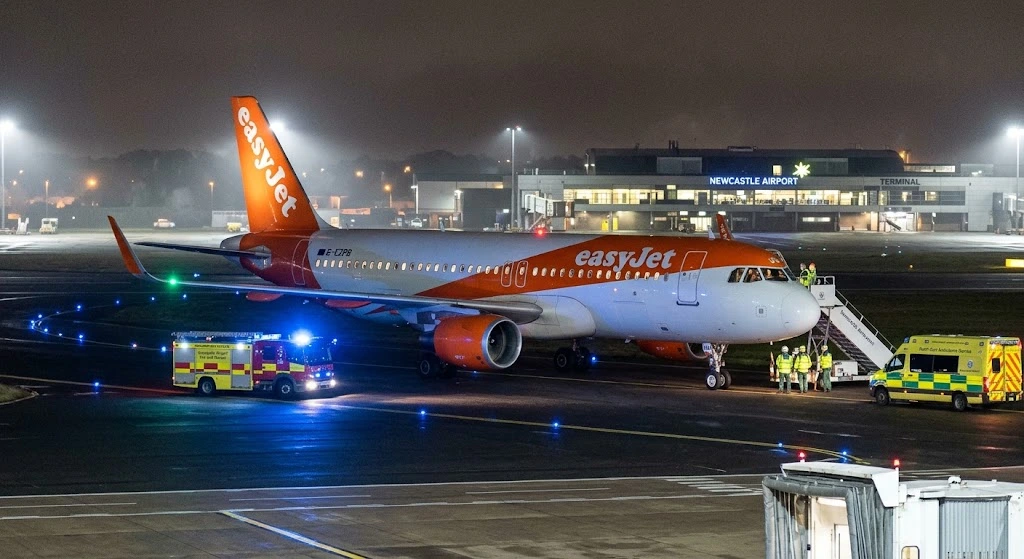
A routine Monday night flight from Copenhagen to Manchester turned into an emergency diversion over the North Sea. One passenger needed urgent medical help. The crew acted fast, declared an emergency, and landed at Newcastle Airport within minutes. This is the full account of the EasyJet Flight U2238 Emergency Landing Newcastle—the decisions, the timeline, and the people behind the headlines.
What Was EasyJet Flight U2238?
EasyJet Flight U2238 is a scheduled service connecting Copenhagen Airport (CPH) to Manchester Airport (MAN). On 27 October 2025, the flight was operated by an Airbus A320-214 registered G-EZPB, a narrow-body jet that had been with easyJet since February 2016.
The aircraft carried 178 passengers and six crew members. Only two seats were empty. The flight pushed back from Copenhagen at 22:13 CET, already 28 minutes behind its scheduled 21:45 departure.
- Flight number: U2238 / EZY2238 (easyJet’s ICAO code is EZY)
- Route: Copenhagen (CPH) → Manchester (MAN)
- Aircraft: Airbus A320-214, registration G-EZPB
- Passengers: 178
- Crew: 6
- Date: Monday, 27 October 2025
Why the Crew Declared an Emergency
As the aircraft crossed the North Sea, a passenger’s condition deteriorated rapidly. Cabin crew assessed the situation and determined that the person needed medical care beyond what the aircraft’s onboard emergency kit could provide. The flight deck was alerted immediately.
The captain did not wait. He declared an emergency by squawking transponder code 7700—the universal signal for distress that triggers priority handling from air traffic control. UK controllers responded at once, clearing airspace and notifying Newcastle Airport to prepare for an emergency arrival.
This was not a technical fault. It was a medical emergency—a situation where minutes can make a measurable difference to a passenger’s survival and recovery.
The 7700 Squawk: A Universal Call for Help
Squawking 7700 is one of the most recognised actions a pilot can take. It tells every controller and every nearby aircraft that the flight needs immediate priority. In this case, the squawk set off a chain of events:
- Air traffic control cleared a direct path to Newcastle.
- Newcastle Airport’s emergency services were deployed to the runway.
- At least one other flight—Air France AFR1558—was placed in a holding pattern to keep the airspace clear for the easyJet aircraft.
The squawk is not a sign of panic. It is a sign of training. The crew followed procedure, and the system worked exactly as it should.
Why Newcastle Airport Was the Right Choice
Manchester was still roughly 30 minutes away when the emergency was declared. For a seriously ill passenger at 38,000 feet, that gap mattered.
Newcastle Airport offered four decisive advantages at that moment:
- Shortest flight time from the aircraft’s position over the North Sea.
- Full commercial runways rated for Airbus A320 operations.
- 24-hour on-site emergency services, ready the moment the squawk was received.
- Direct road access to the Royal Victoria Infirmary (RVI) in Newcastle city centre.
The crew altered course and descended toward Tyneside. Newcastle was not a random diversion. It was the logical one.
The Landing: 22:52 GMT on Runway 25
EasyJet Flight U2238 touched down at Newcastle Airport at 22:52 GMT on Runway 25. Paramedics were already in position on the runway. They boarded the aircraft and took over care of the passenger at the gate.
The passenger was transferred directly to the Royal Victoria Infirmary, which houses the Great North Major Trauma Centre and Emergency Department. The RVI handles around 138,000 emergency patients each year and is the designated major trauma facility for the entire North East of England.
The 177 remaining passengers stayed on board. No other passengers or crew members required medical attention.
What Happened to the Passenger?
The passenger was met by medical services on arrival and transported to the RVI for further treatment. EasyJet’s official statement confirmed the chain of events: “Flight EZY2238 from Copenhagen to Manchester on 27 October diverted to Newcastle, due to a customer onboard requiring urgent medical attention. The customer was met by medical services on arrival, and the flight continued to Manchester”.
The North East Ambulance Service received the call at 22:33 GMT, dispatched an ambulance crew to Newcastle Airport, and transported one patient to the RVI. The response was fast, coordinated, and focused on the person who needed help.
What Happened to the Other Passengers?
The 177 passengers who remained on board experienced a delay, not a danger. They were kept informed. EasyJet sent a message to passengers: “We’re very sorry that your flight has now been diverted. This is due to a passenger welfare issue”.
Once the passenger had been transferred to hospital, engineers carried out standard post-incident checks on G-EZPB. No technical faults were found. The aircraft departed Newcastle at 00:02 GMT on 28 October and landed at Manchester at 00:28 GMT, covering the remaining distance in about 26 minutes.
The flight arrived in Manchester close to two hours behind schedule. The airline classified the disruption as an “extraordinary circumstance outside of our control”—a standard designation for events that are not the airline’s fault and cannot be avoided.
The Aircraft: G-EZPB
G-EZPB is an Airbus A320-214 with Sharklet winglets, construction number 6977. It has been in easyJet’s fleet since February 2016 and is based at London Gatwick. The A320 family is the backbone of easyJet’s operation; the airline operates one of the largest single-type fleets in Europe.
The aircraft returned to service after the diversion. No mechanical issues were reported.
How Airlines Handle In-Flight Medical Emergencies
Medical emergencies at altitude are rare, but they are not unexpected. Airlines train cabin crew to assess passengers, use onboard medical kits, and communicate with the flight deck when a situation escalates. The decision to divert rests with the captain, who weighs:
- The passenger’s condition and the care available on board.
- The distance to the nearest suitable airport.
- The airport’s emergency medical infrastructure.
- The impact on other passengers and the wider air traffic system.
In this case, the captain’s decision was straightforward: Newcastle was closer, equipped, and ready. The EasyJet Flight U2238 Emergency Landing Newcastle demonstrates how a well-trained crew and a prepared airport can turn a potentially critical situation into a controlled, effective response.
What This Incident Teaches About Air Travel Safety
Three lessons stand out from this diversion.
First, speed matters. The crew identified the problem, declared the emergency, and landed the aircraft in under 40 minutes from the squawk. That speed came from training, not luck.
Second, the system is designed for this. Air traffic control, airport emergency services, and ambulance crews operate on shared protocols. The 7700 squawk is not a distress call into the void; it activates a network.
Third, passengers are resilient. The 177 people on board continued their journey. They arrived later than planned, but they arrived safely. The disruption was real, but it was managed with a clear priority: the wellbeing of the person who needed help.
The Aftermath and What Comes Next
EasyJet has announced a new three-aircraft base at Newcastle Airport, set to open on 22 March 2026, bringing 11 new routes and a larger presence in the North East. The diversion on 27 October 2025 was not connected to that expansion, but it highlighted the airport’s capability to handle emergency arrivals from commercial aircraft.
For the passenger, the story moved from the cabin to the hospital. For the crew, it was a night of professional execution. For the 177 other passengers, it was a delay they will likely remember—and a reminder that air travel safety is not an abstract concept. It is a system of people, procedures, and decisions working together.
A Final Word: What You Can Take Away
The EasyJet Flight U2238 Emergency Landing Newcastle is not a story about fear. It is a story about response. A passenger became ill. A crew acted. An airport was ready. A hospital received the patient. A flight continued.
If you take one thing from this account, let it be this: when something goes wrong at 38,000 feet, the people on the flight deck and in the cabin have trained for that moment. The system behind them—controllers, paramedics, airport staff—has trained for it too. That is why a night that could have ended differently ended with a safe landing and a passenger in care.