TXMyZone (Myzone) in 2026: The Complete Guide to Effort-Based Fitness Tech

Introduction
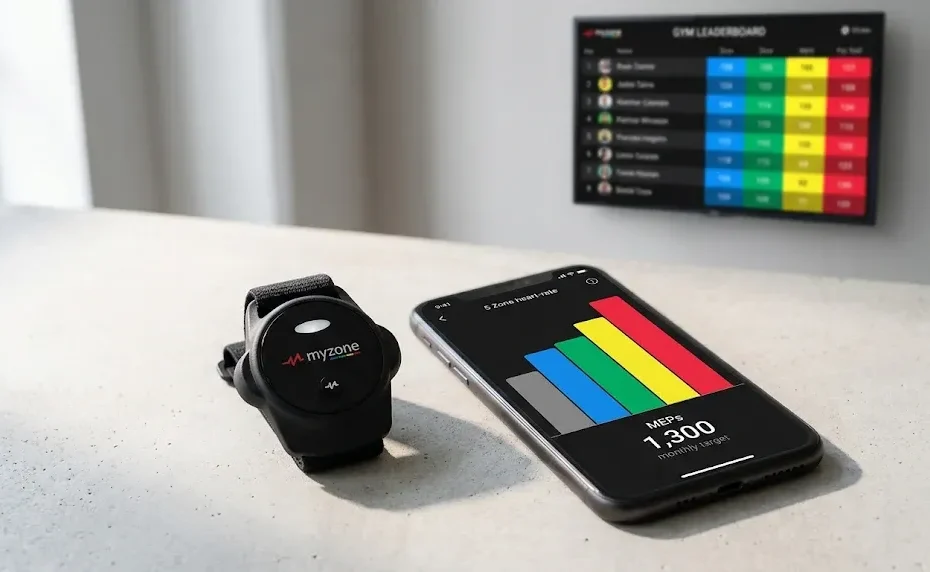
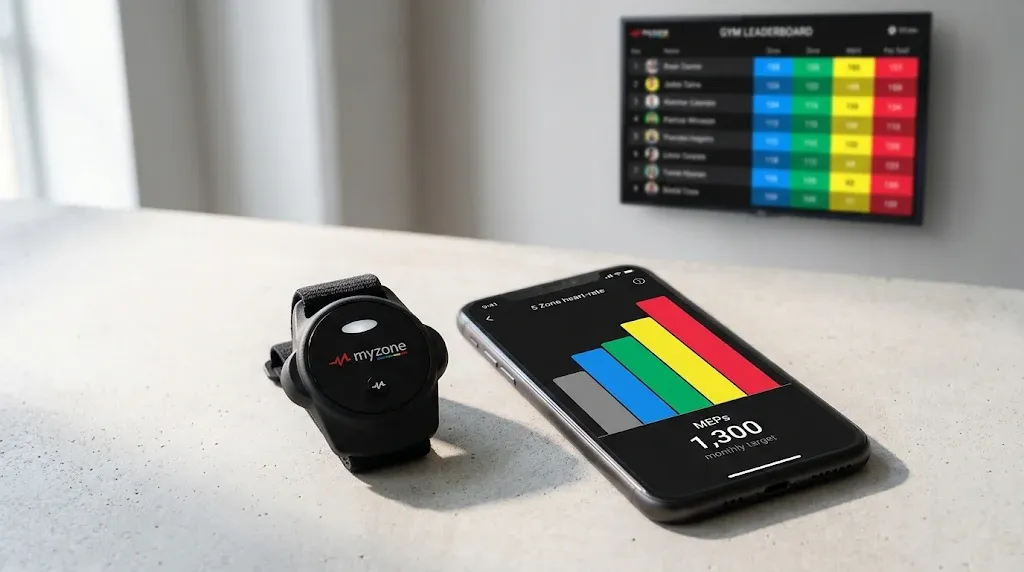
If you’ve walked into a gym recently and seen a wall-mounted screen glowing with coloured heart-rate zones and a leaderboard of names, you’ve already met TXMyZone. It’s the technology behind those live displays—and in 2026, it’s no longer just for gym-goers who buy a dedicated chest strap.
The biggest shift this year is accessibility. Myzone has opened its ecosystem to Garmin users, introduced strength training into its scoring model, and launched a new generation of hardware. If you dismissed it before because it felt belt-only or cardio-centric, the calculus has changed.
This guide gives you the full picture: how the scoring actually works, what’s genuinely new, what it costs, where it falls short, and who should seriously consider it. No hype, no recycled talking points—just the 2026 reality.
Quick Overview: TXMyZone at a Glance (2026 Edition)
- What it is: A heart-rate wearable ecosystem that converts relative effort into MEPs (Myzone Effort Points).
- The core promise: A beginner and an elite athlete can “win” the same session if they both work hard for their fitness level.
- 2026 headline changes: Strength Tracking, native Garmin integration, and the Switch 2.0 sensor.
- Monthly target: 1,300 MEPs, aligned with World Health Organization activity recommendations.
- New gamification: Weekly Streaks reward 325 MEPs per week, with streak freezes to protect consistency.
- Access model: Still strongest inside partner gyms, but now viable for solo users via smartwatch integration and an optional subscription.
What Is TXMyZone—and Why “TX” Keeps Showing Up
TXMyZone is the search-friendly variation of Myzone, the brand name you’ll find on the hardware, app, and official website. The “TX” prefix reflects regional search behaviour and shorthand, but the product is identical: a sensor, a strap or wearable, and an app that together turn your heart rate into a score you can chase.
Definition: Myzone is a heart-rate-based motivation system that measures effort as a percentage of your maximum heart rate and converts that effort into Myzone Effort Points (MEPs).
Unlike a step counter or a calorie tracker, this system doesn’t compare you to anyone else. It compares you to your own capacity. That single design choice is what makes it feel different from almost every other wearable on the market.
How the MEPs System Works: The Engine Behind TXMyZone
Everything in the ecosystem flows from MEPs. Every minute you move, your heart rate is sorted into one of five colour-coded zones, and you earn points based on intensity.
| Heart Rate Zone | % of Max Heart Rate | MEPs per Minute |
|---|---|---|
| Grey | 50–59% | 1 |
| Blue | 60–69% | 2 |
| Green | 70–79% | 3 |
| Yellow | 80–89% | 4 |
| Red | 90–100% | 4 |
Source: Myzone’s official MEPs breakdown
The recommended monthly target is 1,300 MEPs, which aligns with the World Health Organization’s physical activity guidelines for adults—150 to 300 minutes of moderate-intensity activity per week, or the equivalent. That translation matters: it turns a public-health recommendation into a daily, gamified habit you can actually track.
Here’s the part most people miss: chasing the red zone constantly is not the goal. Myzone’s own guidance encourages mixing zones and prioritising recovery. Fitness improves more from your ability to transition between intensities than from living at maximum heart rate.
The 2026 Updates That Changed Everything
Myzone used the HFA Show in San Diego to announce three major product shifts, all rolling out through 2026. Together, they represent the brand’s move from a hardware-first belt company to a software-first engagement ecosystem.
Strength Tracking: Lifting Finally Counts
For the first time, Myzone is expanding its effort-based model beyond cardio. Strength Tracking recognises and rewards resistance training, allowing members to earn effort points during strength-based workouts. That brings the gamified engagement model to lifters, circuit trainers, and hybrid athletes who previously saw little value in a heart-rate-only score.
This is a significant philosophical shift. It doesn’t turn Myzone into a rep counter—it doesn’t pretend to know your 1RM—but it acknowledges that hard lifting has a cardiovascular cost worth recognising.
Garmin Integration: Your Watch Now Earns MEPs
This is the update with the widest impact. Previously, participation required a dedicated Myzone belt. Now, any Garmin watch that syncs to Garmin Connect can feed workouts directly into the Myzone ecosystem and earn MEPs automatically.
The mechanics are straightforward:
- You need an active Myzone Go subscription (currently $6.99/month in the US).
- You connect through the Myzone app’s “My devices” menu, linking your Garmin Connect account.
- Compatible models with Bluetooth Heart Rate Broadcasting can even stream real-time MEPs and heart rate onto in-club screens.
There’s an important limitation: you can only connect one smartwatch at a time. If you already have an Apple Watch or Wear OS device linked, you’ll need to disconnect it before adding Garmin.
Switch 2.0: The Most Versatile Sensor Yet
The Switch 2.0 is the next generation of Myzone’s interchangeable wearable. It improves on comfort, durability, accuracy, and usability, and it can be worn on the chest, arm, or wrist—switching between modes as your workout demands.
The accuracy story is clear and honest:
- 99.4% on the chest using an ECG sensor, equal to equipment used by health professionals.
- 95% on the arm or wrist using optical PPG sensing.
Battery life sits at three to six months between charges, and it’s waterproof to 10 metres. The redesigned sensors deliver stronger wireless connectivity and more reliable readings, so the data you see is data you can trust.
TXMyZone vs Whoop vs Polar: Which System Fits Your Training?
TXMyZone isn’t the only heart-rate system worth considering. Here’s how it compares to two established alternatives, based on 2026 positioning.
| Feature | TXMyZone (Myzone) | Whoop | Polar (H10 + app) |
|---|---|---|---|
| Primary focus | Effort-based motivation & gym community | Recovery, sleep & strain | Raw HR accuracy & outdoor training |
| Scoring model | MEPs (effort points) | Strain score + recovery score | No proprietary effort score |
| Hardware model | Belt or Switch sensor; smartwatch integration via Myzone Go | Subscription wearable (no screen) | Chest strap + free app |
| Gym integration | Strong—live screens, challenges, leaderboards | Minimal | Minimal |
| Recurring cost | Optional Myzone Go ($6.99/mo) for smartwatch use | Required membership (tiered, annual) | Free app |
| Best for | Accountability & group motivation | Recovery optimisation | Data-driven solo athletes |
Sources: 2026 comparison analyses and manufacturer specifications
The distinction is philosophical. Whoop asks: “How recovered are you?” Polar asks: “How accurate is your heart rate?” TXMyZone asks: “Did you show up and try?” If your struggle is consistency inside a gym environment, that third question is often the one that matters most.
For a physiological benchmark on what different heart-rate zones mean, the American Heart Association’s target heart rate guidance is a useful reference point—it explains why personalised zones matter more than generic calorie counts.
The Real Costs: Hardware, Subscriptions, and Value
The financial picture in 2026 is more flexible than it used to be, but it’s not free.
Hardware
- Myzone Switch 2.0: Around **$159.99** at retail, with gym-member pricing sometimes lower (for example, $180 AUD at some partner facilities).
- Chest straps (MZ-3, etc.): One-time purchase, no subscription required for core functionality.
Subscriptions
- Myzone Go: **$6.99 per month** (or roughly $38.99 for six months, or $61.99 annually). This is required to connect your own smartwatch—Garmin, Apple Watch, or Wear OS—to the ecosystem.
- Free tier: The app is free to download and use with a Myzone device; the subscription unlocks smartwatch integration and broader ecosystem access.
The Value Question
If you already own a Garmin or Apple Watch and train at a Myzone-partner gym, the $6.99/month is arguably the cheapest route into the ecosystem—no belt purchase required. If you’re buying dedicated hardware, the Switch 2.0 is a one-time cost that works without a subscription for core MEPs tracking.
The trade-off is clear: hardware gives you accuracy and independence; subscription gives you flexibility and smartwatch integration.
TXMyZone Status and Weekly Streaks: The Gamification Layer
Two systems keep motivation alive beyond the daily workout: Myzone Status and Weekly Streaks.
Myzone Status
Status is a ranking system tied to 1,300 MEPs per month. Every consecutive month you hit the target, your status increases by one level. Missing a month causes a drop—first to the beginning of your current level, then to a lower level if you miss consecutive months. Once you reach the Hall of Fame (after roughly four years of consistency), you can never drop below it.
Weekly Streaks
Weekly Streaks are designed to reward effort more frequently. Hitting 325 MEPs in a week (Monday–Sunday) extends your streak. If you maintain a four-week streak, you earn a streak freeze that protects you if you miss a week. A twelve-week streak earns two freezes. Crucially, freezes apply to weekly streaks only—not to monthly Status.
This layered approach solves a real behavioural problem: monthly targets feel distant, but weekly targets feel achievable. The freeze mechanic acknowledges that life happens without letting one bad week erase months of consistency.
Who Should Use TXMyZone (and Who Should Skip It)
A Strong Fit If:
- You train in a gym that uses Myzone screens, challenges, or leaderboards.
- You want accountability that doesn’t punish you for being a beginner.
- You enjoy gamified fitness—badges, status levels, streaks.
- You already own a compatible smartwatch and want to unify your effort data.
- You lift as well as do cardio and want both recognised.
Might Skip If:
- You train exclusively outdoors or at home with no gym ecosystem.
- You’re looking for deep recovery, sleep, or readiness tracking (Whoop is stronger there).
- You want a single one-time purchase with zero subscription layer.
- You dislike social or competitive fitness features.
Honest Limitations: What TXMyZone Still Doesn’t Do Perfectly
No system is flawless, and the 2026 updates don’t erase every trade-off.
The gym ecosystem is still the centre of gravity. The live-screen, community-driven magic only works in partner facilities. Solo outdoor users get MEPs tracking but lose the social layer that makes Myzone distinctive.
Accuracy drops off the chest. At 99.4% on the chest, the ECG sensor is genuinely medical-grade. On the wrist or arm, 95% is still strong for optical tracking, but it’s a step down. If precise zone work matters to you, the chest strap remains the gold standard.
Customer support reviews are mixed. Independent review aggregation shows high overall app ratings (4.8 stars from over 22,000 ratings) but also recurring complaints about connectivity issues, data syncing, and customer service responsiveness. The product is well-loved by many, but it’s not immune to support friction.
The subscription is an ongoing commitment. Smartwatch integration requires Myzone Go. For some users, that’s fair value; for others, it’s an unwanted recurring cost on top of hardware or an existing gym membership.
Key Takeaways
- TXMyZone rewards effort, not ability—making it one of the most inclusive motivation systems available.
- MEPs are the currency: 1,300 per month is the Status target; 325 per week drives Weekly Streaks.
- 2026 brought three major upgrades: Strength Tracking, Garmin integration, and the Switch 2.0 sensor.
- The ecosystem is strongest inside partner gyms with live screens and community challenges.
- Smartwatch integration is subscription-gated at $6.99/month, but it removes the need for dedicated hardware.
- Chest-worn accuracy is 99.4%; arm and wrist drop to 95%, which is still strong for optical sensing.
FAQ: Real Questions, Direct Answers
Is TXMyZone the same as Myzone?
Yes. TXMyZone is a common search variation for the Myzone brand. The product, app, and MEPs system are identical. “Myzone” is the official name used on hardware and the website.
How accurate is the Switch 2.0 heart rate sensor?
On the chest, 99.4% using ECG—equal to professional-grade equipment. On the arm or wrist, 95% using optical PPG sensing. Battery lasts three to six months, and it’s waterproof to 10 metres.
Can I use TXMyZone without a gym membership?
Yes, but you lose the live-screen and community features that make it distinctive. The app still tracks MEPs and workouts, but the social motivation layer is built around partner facilities.
Do I need a subscription to use my Garmin with Myzone?
Yes. Garmin integration requires an active Myzone Go subscription, currently $6.99/month in the US. Once connected, compatible Garmin workouts feed MEPs automatically into the ecosystem.
What is a good monthly MEPs target?
1,300 MEPs per month is the recommended target, aligned with World Health Organization exercise guidelines. It’s also the benchmark for Myzone Status progression.
Is TXMyZone good for strength training in 2026?
Yes—better than ever. The new Strength Tracking feature expands the effort model into resistance training, so hard lifting sessions now contribute to your MEPs total. It’s an effort recogniser, not a rep counter.
Conclusion
TXMyZone in 2026 is a more complete product than it has ever been—not because it added features for the sake of a spec sheet, but because it removed the barriers that kept people out. Strength training now counts. Your existing Garmin watch now earns MEPs. The hardware is more versatile and more accurate. And the gamification layer—Status, Streaks, freezes—is designed around the real psychology of consistency, not just the fantasy of motivation.
If your struggle is showing up, this system was built for you. If you train in a partner gym, the value is almost immediate. If you’re solo and outdoor-focused, the calculus is different—but the gap is narrowing every year. The effort-first philosophy remains the most human idea in fitness tech, and in 2026, it’s finally accessible to more people than ever.