Matarecycler in 2026: The Updated Truth Behind the Smart Recycling Name

Short Intro
You’ve seen the word by now. Maybe in a blog post promising AI-powered bins that sort your trash automatically. Maybe in a social feed describing a platform with computer vision, sensors, and an app that tracks your environmental impact. The term matarecycler sounds like the future of recycling — until you try to find the company behind it.
That’s the problem. In 2026, the gap between the idea and the evidence has only become clearer. This updated guide walks through what’s new, what hasn’t changed, and what you can actually do — with or without a branded device.
Quick Overview Box: What’s New in 2026
- No verifiable company behind the product version of MataRecycler has been confirmed in 2026 — the same conclusion reached by multiple independent reviews this year.
- The name is used inconsistently: some sites describe recycling technology; others use “MataRecycler” for biofuel, content marketing, or general sustainability writing.
- Real AI sorting had a landmark year: Greyparrot raised $27M and achieved a UK regulatory first; AMP Robotics secured a 20-year municipal contract and $70M in financing.
- EPA-linked data still shows ~25% contamination in the U.S. recycling stream, with a national recycling rate just above 32%.
- The World Bank’s What a Waste 3.0 (March 2026) provides the newest global waste dataset, covering 217 countries.
- The practical takeaway hasn’t changed: source-level sorting improves outcomes, whether or not you use a branded platform.
1. What “Matarecycler” Means in 2026 — and Why the Confusion Persists
The word still splits into two meanings, and the 2026 evidence has made that split sharper, not softer.
In one sense, a matarecycler describes a role or a principle: processing materials at the point of origin — your kitchen, a cafeteria, a packaging plant — before waste enters the traditional recycling chain. The goal is to intercept material before contamination ruins its value. That idea is sound, and it doesn’t require a product name.
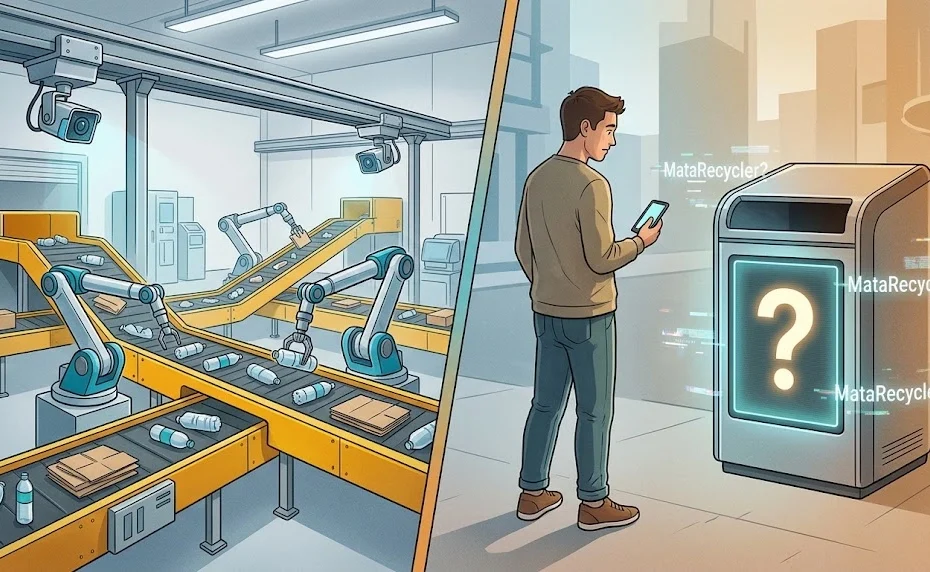
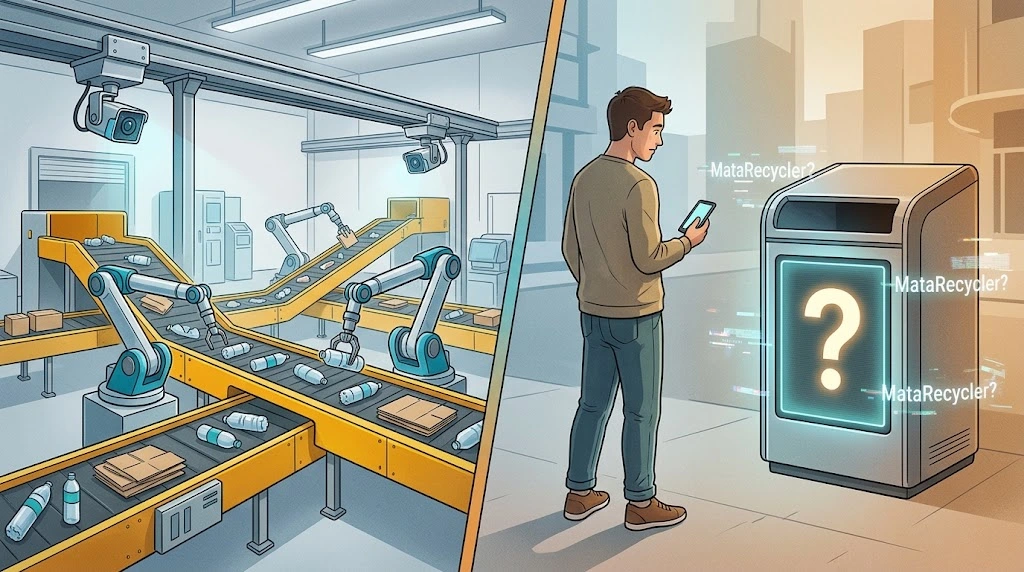
In the other sense, “MataRecycler” is presented as a specific AI-powered platform: smart bins with cameras, IoT sensors, automatic sorting, and an app that monitors your individual impact. The description appears on dozens of unrelated websites, often with near-identical wording. Yet, as a 2026 review concluded, “there’s no company behind it, no real customers, no trackable data, and no way to actually buy or use the thing”. No company registration has been found, no municipality has vouched for its use, and there is no pricing page or demo request route.
The confusion persists because the name is being used for things that have nothing to do with recycling hardware at all. One 2026 site uses “MataRecycler” to describe a content-repurposing service for bloggers and marketers. Another applies the name to biofuel and ethanol production. When a single word can mean smart bins, content marketing, and fuel oil, the name itself doesn’t point to a coherent product.
2. Why the Smart Recycling Claims Still Don’t Hold Up
The core problem in 2026 is the same as it was before: the claims sound plausible because the underlying technology is real. That’s exactly what makes the unverified version convincing.
Real AI sorting exists. Computer vision can identify plastics on a conveyor; robotic arms can pick items at speed; sensors can separate metals and glass. Because readers already know this world is real, a brand name that borrows its language feels credible. But belief isn’t proof.
A legitimate hardware company leaves a paper trail: a registered business, named installations, third-party coverage, technical specifications, and a way to buy or request a demo. For the product version of MataRecycler, none of those things have been publicly documented in 2026. The statistics attached to it — accuracy percentages, landfill diversion figures — never trace back to a named study, a press release, or a verifiable source. As one analysis put it, real stats have a paper trail; when a number is vaguely attributed to “a report” or “researchers,” it should be treated as unverified until proven otherwise.
That doesn’t automatically mean a private project is impossible. It means the public evidence isn’t there. And when a recycling claim can’t be verified, the responsible response is to treat it as unconfirmed rather than repeat it as fact.
3. The Real Problem: Contamination Is Still the Biggest Barrier
Strip away the branding, and the matarecycler conversation points to a genuine crisis that hasn’t gone away: contamination.
Recycling only works when the right materials reach the right facility in usable condition. Greasy pizza boxes, plastic bags tangled in sorting equipment, food residue on jars — these don’t just fail to get recycled themselves. They can drag entire loads down with them. According to the U.S. Environmental Protection Agency’s national recycling data, the national recycling and composting rate sits just above 32%, while contamination rates hover around 25% — meaning roughly one out of every four items people toss in the bin isn’t actually recyclable in that stream.
The consequences are concrete. Lithium-ion batteries crushed in sorting equipment have been linked to more than 5,000 MRF fires. Wet or greasy paper can ruin an entire fiber bale, sending the whole bundle to landfill. Plastic film and hoses wrap around rotating machinery and force shutdowns. In some states, repeated contamination violations now carry fines.
That gap between intention and outcome is where the source-level concept becomes useful. If you sort better at home, you send cleaner material downstream. If a business sorts better at the back dock, it sells higher-value feedstock instead of paying to landfill contaminated bales. No AI required — just better habits and clearer local rules.
4. What Real Smart Recycling Looked Like in 2026
If you want to see what a legitimate smart sorting ecosystem looks like in 2026, the news came from companies with named facilities, funding rounds, and regulatory milestones — not from anonymous content sites.
Greyparrot had a landmark year. In July 2026, the London-based AI waste-intelligence company raised $27 million in Series B funding, bringing its total to $60 million. More significantly, its AI-generated waste composition data became the first to be accepted by the UK Environment Agency for regulatory reporting, based on measurements at named Biffa and FCC sites. Its cameras now operate in more than 20 countries above conveyors run by operators including WM, Veolia, and Biffa.
AMP Robotics secured a 20-year contract with the Southeastern Public Service Authority (SPSA) in Virginia to process waste for 1.2 million residents, expanded its Portsmouth facility to 108,000 tons of municipal solid waste annually, and raised $91 million in Series C financing. It was also named to the 2026 Global Cleantech 100 for the seventh consecutive year.
TOMRA continued deploying deep-learning sorting systems across recycling and mining, opening a new Americas Test & Training Center equipped with its GAINnext™ AI technology and reporting defect-removal rates above 97% in food-processing installations.
The pattern is consistent: real players name their technology, their facilities, and their clients. A vague promise of “AI-powered recycling” doesn’t meet that bar.
Definition box: Smart recycling isn’t one standardized product. It’s an umbrella term for sensor-equipped bins, automated sorting lines, and software that tracks material flows. Each solves a different problem — and none of them replaces the need for accurate local collection rules.
5. How to Evaluate Any Recycling Platform in 2026
The matarecycler confusion offers a useful lesson in evaluating environmental claims more broadly. In 2026, the global waste picture makes that skepticism more important, not less.
The World Bank’s What a Waste 3.0, published in March 2026, is the newest comprehensive dataset on municipal solid waste, drawing on data from 217 countries and economies and 262 cities. It consolidates figures on generation, composition, collection, treatment, and disposal, and tracks trends by region and income group. Industry statistics compiled in 2026 estimate that the world generates over 2.01 billion tons of municipal solid waste annually, with a global average recycling rate of around 33% — varying from 5% to 65% by country. At least 33% of global waste is not managed in an environmentally safe manner.
With stakes that high, hype doesn’t help. Before trusting any platform, run a few checks:
| What to look for | Why it matters | Red flag |
|---|---|---|
| Named installations | Proves the system operates somewhere real | Only “pilots” with no city, date, or facility |
| Third-party coverage | Independent outlets have verified the claims | Identical articles across unrelated sites |
| Technical specs | Shows the product is engineered, not just described | No manual, no safety info, no support details |
| A way to buy or demo | Confirms a functioning business exists | No pricing page, no contact route beyond a generic blurb |
| Traceable statistics | Lets you check the number at its source | “A report says…” with no link or author |
If a platform fails most of these, it may still be an early-stage project — but you shouldn’t treat it as an established solution. And you definitely shouldn’t repeat its numbers as fact.
6. Practical Steps That Work Without a Brand Name
You don’t need a smart bin to improve recycling outcomes in 2026. These steps are boring, but they’re backed by how recycling systems actually function.
- Learn your local accepted list. Not the national list, not the recycling symbol on the package — your municipality’s actual rules. A resin code tells you what type of plastic an item is, not whether your facility takes it.
- Rinse food containers. A quick rinse removes the residue that causes contamination and protects the rest of the load.
- Keep plastic bags and film out of curbside bins. They wrap around sorting equipment and shut down lines. Return them to store drop-offs instead.
- Separate organics if your area offers it. Food waste is one of the biggest contaminators of dry recycling streams.
- Buy less packaging when you can. Recycling sits below reduction and reuse in the waste hierarchy. The best material to process is the one you never generated.
At the community level, source separation still works. Kamikatsu, Japan, remains the benchmark — dozens of categories, near-zero-waste outcomes. You don’t have to go that far, but the principle holds: cleaner input, better output.
Key Takeaways Box
- “Matarecycler” is not a verified company in 2026 — it’s a term used for a useful concept, an unproven product claim, and several unrelated topics.
- Real AI sorting had a breakthrough year, with Greyparrot’s regulatory first and AMP’s 20-year municipal contract.
- Contamination remains the biggest practical barrier, with roughly one in four U.S. recycling items not actually recyclable.
- Source-level sorting improves recovery quality whether or not you use a branded device.
- Check the paper trail before trusting any platform: named installations, specs, third-party coverage, and traceable data.
- Global waste data is now more detailed than ever, thanks to the World Bank’s 2026 What a Waste 3.0.
FAQ
What is matarecycler in simple terms?
“Matarecycler” is an online term used in two ways: to describe sorting recyclables at the source before contamination occurs, and to name an unverified smart-bin platform. The concept is useful; the product claims lack public evidence in 2026.
Is MataRecycler a real company?
As of late 2026, no verifiable company registration, named municipal client, pricing page, or independent product test has been publicly confirmed. The name appears across many content sites, but a commercial hardware business behind it hasn’t been documented.
Does AI recycling technology actually exist?
Yes. Greyparrot, AMP Robotics, and TOMRA sell computer-vision and robotic sorting systems to real materials recovery facilities and have documented installations, funding, and contracts. The technology is real — but a specific brand name still needs its own proof.
Why is recycling contamination such a big deal?
Contamination — food residue, plastic bags, wrong materials — can cause entire loads to be rejected and landfilled. In the U.S., roughly one in four items in the recycling stream isn’t actually recyclable, according to EPA-linked reporting.
What’s new in global recycling data for 2026?
The World Bank published What a Waste 3.0 in March 2026, covering 217 countries and 262 cities. It provides the most detailed snapshot yet of global waste generation, composition, and treatment trends through 2050.
What can I do if I’m not sure whether something is recyclable?
Check your municipality’s accepted-materials list. When in doubt, throw it out rather than risk contaminating a whole load. Rinse containers and keep plastic bags out of curbside bins.
Conclusion
The matarecycler story in 2026 is a reminder that a good idea and a real product aren’t the same thing. The idea — sort earlier, contaminate less, recover more — is sound and worth practicing. The product claims need evidence that, so far, isn’t publicly available.
Meanwhile, the real work is happening elsewhere: in facilities with named clients, in funding rounds that pay for installations, and in regulatory decisions that accept data from verified systems. That’s where the future of recycling is being built — not in a name that means everything and nothing.
So the next time a shiny recycling solution crosses your feed, don’t ask whether it sounds smart. Ask where it’s installed, who uses it, and whether you can trace its numbers back to a source. That habit will serve you better than any bin.